
Tag Archives: Czech Republic

Parish Festivals

Parish festivals bring families together

Much like in the USA, many festivals in Czech Republic are tied to churches and their patron saints. We’ve just experienced a great St. Patrick’s parish festival here in Parnell last weekend. For the first time we could all enjoy it together as a family. It was a family reunion at its best.

My daughter Emma Palova-Chavent arrived from France on Tuesday prior to the festival with her daughter Ella. And my parents Ella and Vaclav came from Big Rapids. To my big surprise even my brother Vas peddled on his bike 75 miles from Paris, Michigan to Lowell for the festival. My son Jake came for the chicken dinner from Kalamazoo.
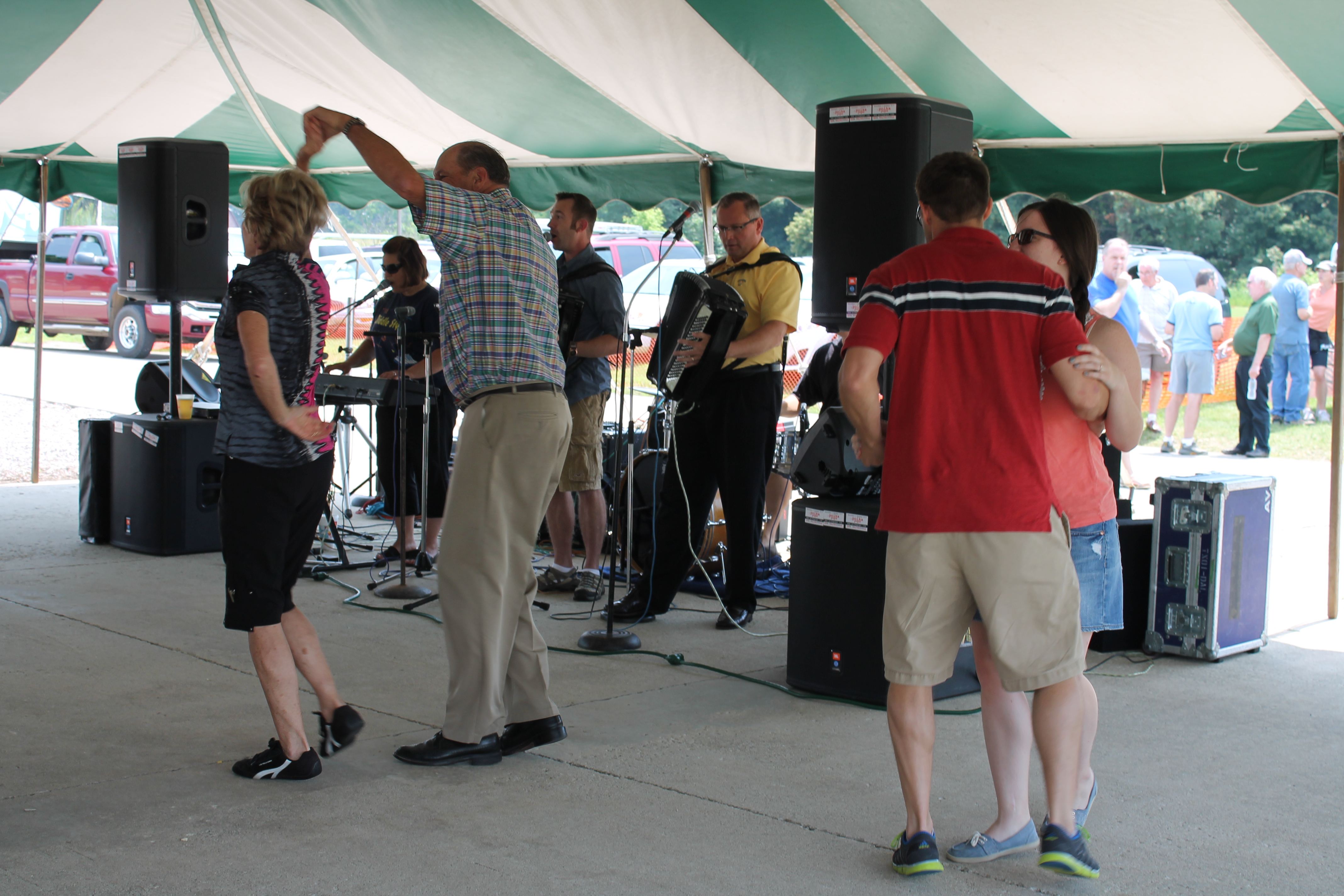
Polka dance at St. Pat's Parish Festival last Sunday.
Polka dance at St. Pat’s Parish Festival last Sunday.

I was also mildly surprised by the $3 admission charge to play in the Las Vegas tent. My daughter and I always lose a lot more than just $3. We all went Sunday to the festival to enjoy the chicken dinner and mainly the polka music by the Diddle Styx Polka Band.

It felt almost like back home in Czech Republic during the Saint Mary’s Pilgrimage days in September that will now be held on the brand new Marian Square in front of the medieval church. Both Czechs and Germans love to listen, sing or whirl a polka.

We always came to visit with my in-laws for the Marian festival in Stipa, along with other family members.  I write about this in my memoir “Greenwich Meridian,” because the church has quite often inspired me for its opulent baroque interior with a beautiful organ. My uncle Tony used to play the organ. I was married in that church, and funeral masses for most family members were held there.

The Pala and Konecny families enjoy chicken dinner at the parish festival.

Most women in the village including my mother-in-law Julie baked and cooked up a storm for the Marian festival, as the families got together from far and near. We usually had schnitzels, which are breaded pork chops, and mashed potatoes with home canned compote. For dessert, we had the traditional “kolache” pastries filled with plum butter and cottage cheese.

There was a dance on the night before the festival Sunday, much like here in Parnell. I can think of only a minor difference between the two events. Carnival rides always accompanied the Marian feast, while classic car and antique car show embellish St. Pat’s festival. We didn’t have raffles or auctions, but we had colorful paper roses on wires from the carnival caravans as souvenirs from the Marian festival.

Saint Mary's church in Stipa, Czech Republic during Marian pilgrimage days.
Saint Mary’s church in Stipa, Czech Republic during Marian pilgrimage days.

The Marian event in Stipa is officially called a pilgrimage, because originally people made pilgrimages to a small chapel with one of the oldest statues of Virgin Mary in Moravia that stood in place of the church. We made a pilgrimage once from our Zlin apartment to the Marian church in 1978 when I was pregnant with my daughter. We walked approximately seven kilometers across the Southern Slopes and along the narrow roadway to Stipa.

Pilgrimages are still common in Europe to places like Fatima in Portugal and Lourdes in France, as well as Hostyn in Czech Republic.

Copyright @2013 story and photos by Emma Palova

A love to travel

Czechs love to travel

Burgas boasts beaches like Sunny Coast on the Black Sea.

As I write in my memoir “Greenwich Meridian,” Czechs have an obsession with travel; partially due to the fact that during communism, travel was only allowed to the countries in the Eastern Block. And just like with anything else, what is prohibited attracts the most.

The only semi-capitalist country that the government allowed people to go to was Yugoslavia, and even that one required exit visa. For a Czech person, Yugoslavia was expensive. So, they canned their food and bought potatoes to bring with them. Usually, they slept in tents there.

But, it was a yuppie thing to do. Because of my immigration past to the USA, I was not allowed to go to any Western country, and not even to the coveted Yugoslavia. I just heard about it from a friend at school who went there the year Elvis died.

On the other hand, I’ve been to two Eastern European countries, and that was Bulgaria in the summer of 1982, and Hungary in 1987.

My husband Ludek and I took a train from Prague to Burgas on the Sunny Coast of the Black Sea. We travelled the distance of 811 miles for two days and one night.

The train became very local in Rumania. It stopped in every village, where people were either begging for food or selling some. You could see gypsies on their wagons, and we did travel through the Transylvanian Alps, home of the famous count Dracula. The train had trouble climbing up the hills and the curves. You could see both locomotives chugging the long train from the back cars.

Bulgarian ceramic pitcher.

Somewhere along the way in Rumania we stopped for a break. We walked into a store to buy some food for the road, and it was completely empty. I wondered why it was opened.

Sunny Burgas welcomed us with a surprise. The vacation was advertised with a stay in a hotel in a Czech travel catalogue. The reality was a trailer camp. I remember crying.

Bulgaria also had so called Russian toilets which were just holes in the ground with two sidesteps to put your feet on. Much like in the rest of Europe, all the restaurants were directly on the beach.

My favorite food was chorba, a hearty stew with home made bread. I’ve been making it ever since. I bought some Bulgarian ceramic souvenirs that I brought with me to the USA.

People were friendly and we spoke Russian, which we all had to learn in schools of the Eastern Block. It came in handy. After many years, when I returned back to the USA with my family, and met a Russian man in a store, I could not remember anything except for “Zdravstvuj tovariscz” which means hello comrade.

…….. to be continued

Copyright © 2013 story by Emma Palova

Monsanto loses Europe

The power of organized masses

I have many times in my life experienced the power of organized masses in demonstrations and revolutions like the Velvet Revolution in 1989 that brought two million people to the Wenceslas Square in Prague. That was the end of communism.

Now, I am witnessing the power of people again in the long drawn out fight against genetically modified (GMO) seed giant Monsanto based in Saint Louis, Missouri, USA. Based on protests, trials, court cases and demonstrations, the company lost all of Europe, except for Czech Republic, Spain and Portugal. Most recent demonstrations took place on May 25th in 436 cities around the world, 250 in the US. Meanwhile we were being fed information on major networks about a fire on a cruise ship with a firefighter on it.

This is an excerpt from an article by colleague Nils Mulvad from Investigative Reporting Denmark titled “GMO lose Europe-victory for environmental organizations.”

Monsanto will halt production of genetically modified corn in all of Europe, except Spain, Portugal and Czech republic. The agribusiness multinational states not to spend any more money on trials, development, marketing, court cases or anything else to get GM corn accepted in Europe.