May in Czech is known as the month of love immortalized by poet Karel Hynek Macha and other writers. In May lovers can be found in parks after the long winter. Also May dances are held in many villages. They’re known as Majales and tall Maypoles are erected and decorated with ribbons. These traditions are now coming back after they were suppressed under communism. Also May prayers called Majove are held outdoors when it is nice by simple chapels.
A castle park in Vizovice where a big part of my book takes place.
Typical flowers for May are lilacs. Some have grown into trees and have been cross bred into different colors. So you can find a blossoming lilac tree in lavender, burgundy and white. The style of many parks was based on English gardens with strict design and hedges such as the one in the picture Vizovice. A lot of my book takes place in this small town of not even 5,000 people in the Moravian region. I went to first grade there, and spend many years growing up in Vizovice, and then taking care of my grandparents.
There are a lot of legends tied to the park and the castle. In the upper part right by the castle, there are two huge statues of ancient fighters with swords. The legend has it that each year, they grow closer together. Then when they finally meet, that will be the end of the world.
Czechs like tales, legends and stories. I don’t know who came up with the one about the statues.
Grandpa Joseph Drabek of Vizovice was the first entrepreneur in the family. He worked for a shoe factory Svedrup as a master sewing machine repairman. He even had his own apprentice. But, on the side he did so called “fusky” or moonlighting for cash. He continued with moonlighting even more so after retiring from Svedrup. Now, that was strictly prohibited under communism, since all private businesses in former Czechoslovakia were nationalized in February of 1948. Penalties for violating the nationalization law included jail time. And grandpa did some.
There were no legal private butcher shops, no funeral parlors, no general stores, no bakeries, no jewelers, and no farmers, just cooperatives. The agricultural land was taken away from farmers, including my second uncles, and put into cooperatives.
So, at a time when any private enterprise was considered an illicit business, grandpa’s biz was flourishing due to the lack of skilled people in his trade.
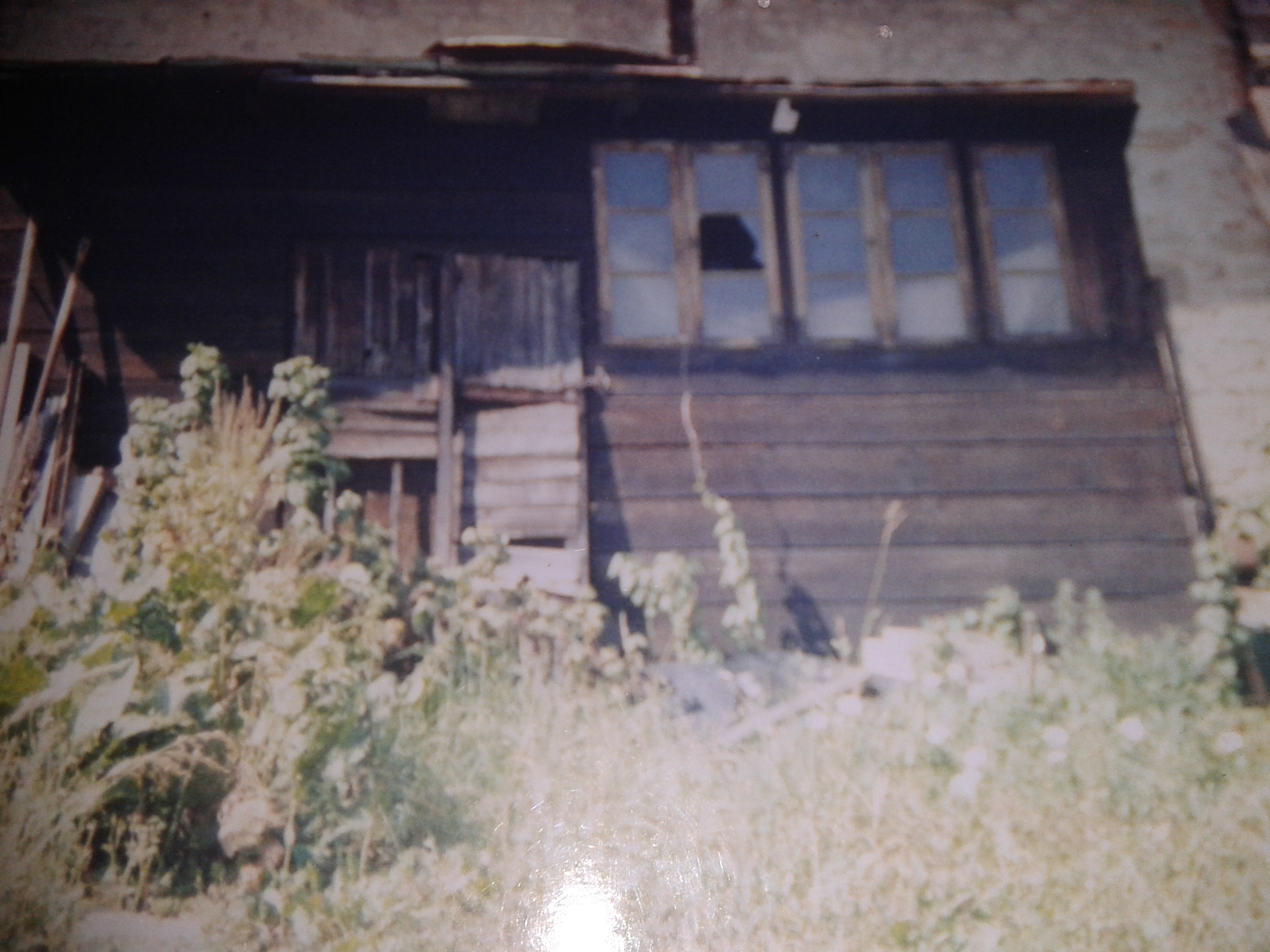
He proudly gave his corporate headquarters a grandiose name, “shoppa.” The shop was a shack put together from scavenger boards and planks, window panes and stolen material from the shoe factory. It was well hidden behind the old house under a walnut tree. Grandpa painted the shop with old oil from his cars, and he got offended when someone called it a shed.
Grandpa’s Shoppa in 2006
Grandpa Joseph spent a lot of time on the road. And that’s when my dad, a professor of math and physics, became a part of the business. Dad couldn’t get a teaching job after returning home from the USA, so grandpa as a true entrepreneur exploited that without hesitation.
Dad chauffeured grandpa around the Moravian region for gas money, instead of teaching calculus and trigonometry. He patiently waited in the car calculating math problems in his head, while jovial grandpa chatted with seamstresses who had broken sewing machines.
Grandpa could be easily recognized from far by his signature beret, blue work shirt with oil streaks, his two leather bags filled with tools, and a little canted walk. He quite often swore at the machines, when he couldn’t fix them.
“Where were you,” mom asked once after the duo had been gone for the entire day.
Well that was part of the problem. We never knew when they were coming home. At a time when even land phone lines were a luxury, it was impossible to track them down.
Grandpa Joseph with my parents in Big Rapids, MI
And it wasn’t unusual for them to end up in strange places, since dad didn’t know the hilly region well.
Grandpa took the business another step further when he put an ad in the local paper advertising his craft. That too was a big no, no. He laughed for the longest time at the single response he got, “Dear Mr. Advertiser.”
No matter what grandpa did, he was a true pioneer ahead of his time.
Grandpa did get to visit with my parents Ella and Vaclav in Big Rapids, Michigan in the late 1980s, soon before he died of cancer. His shoppa survived both him and all the political and development upheaval.
I salute both men, who ever so bravely, journeyed through the countryside to earn an honest crown, that is a good Czech currency.



 authoremmapalova