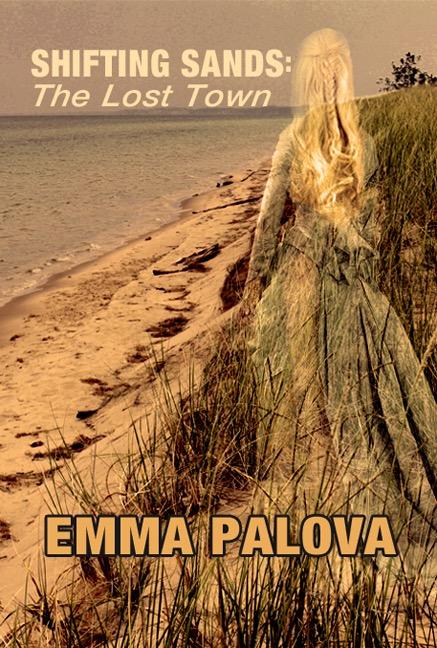
In the third book of the Shifting Sands series- “The Lost Town”- author Emma Palova of Lowell creates the protagonist, Miss Ida. The historical fiction novel is set in the ghost town of Singapore on the shores of Lake Michigan at the foot of the sand dunes adorned with white pines. Beautiful Ida is torn between her hometown of Chicago and her new home on the other side of the lake, and between two men.
Developed by New York investors, the once-thriving settlement of Singapore nurtured the dreams of adventurers like Oshea Wilder and pioneer settlers alike. Singapore would rival Chicago and Milwaukee. It almost did with its sawmills, hotels, boarding houses, stores, and a “wildcat” bank.
Entrepreneurial Ida struggles to adjust to the rough environment but finds more than support in her boss who invited her to Singapore to be the “Mistress” of the Big House. A “wildcat” bank was established in Singapore in 1837.
Who will win Ida’s heart?
Check out the review by Nancy Price Stroosnyder.
Emma’s ease at mixing actual history into her stories is remarkable, and so entails Miss Ida’s response to an invitation to a soon-to-be bustling “Singapore” on the shores of Lake Michigan. She is transported away from Chicago, family, and friends. She quickly learns the duties expected of her in maintaining a boarding house and warehouse in the rapidly growing community. Soon she falls in love with one of the corrupt founders. The many colorful characters weave a fantastic story of love, mystery, hope, and faith. This is a quick, very worthwhile read!
Sponsored by Doc Chavent and The Lowell Ledger, bringing you homegrown stories for more than 100 years.
Palova will be signing her new book The Lost Town at Once Upon A Book in Frankenmuth on July 23 at the Bavarian Inn Lodge from 9 a.m. to 3 p.m., at Fallasburg on July 30, in Holland on Aug. 6 and in Paradise from Aug.19 through Aug. 21.
Check out Emma Palova’s books Greenwich Meridian Memoir about the Konecny family immigration saga from former Czechoslovakia to the USA, books from the Shifting Sands series including the newest one The Lost Town. The historical fiction novel is set in the ghost town of Singapore in Michigan during its bustling lumbering era. Meet Miss Ida and Mr. Bosch, a New York land speculator.
Please check out my virtual booth at Detroit Bookfest from July 15 through July 17. You can get my Greenwich Meridian Memoir about the Konecny family immigration saga from former Czechoslovakia to the USA by clicking on the link below.
My other books from the Shifting Sands series will also be available in the virtual booth including my newest one The Lost Town set in the ghost town of Singapore, MI.
Also, stay tuned for an upcoming episode about The Lost Town on For the Love of Books Podcast at http://emmapalova123.podbean.com
Lowell author & reporter Emma Palova completed The Lost Town, a third book in the Shifting Sands series on the last day of June.
The historical fiction novel is set in Singapore, MI, a ghost town on the shores of Lake Michigan during the pioneer era of the 1830s.
The Lost Town cover by graphic artist Jeanne Boss of Rockford.
Palova captured the spirit of the once thriving lumbering town in its main characters – beautiful Miss Ida, her boss lumber baron John Bosch, Singapore founder Oshea Wilder and supporting characters, Sir Artemas Wallace and housemaid Mrs. Fisch.
Miss Ida was torn between her hometown of Chicago and her new home Singapore, and between two men. Who will win her heart?
The story unravels as the greedy New York investors set their eyes on the undeveloped land at the Oxbow bend in the Kalamazoo River surrounded by sand dunes with much coveted white pines.
Wily Oshea established the New York & Michigan Co. in 1836 to facilitate the development of Singapore. The investors envisioned that Singapore would rival Chicago and Milwaukee. With its humming mills, boarding houses, hotels, and general stores at the height of its prosperity, Singapore almost outshone Chicago.
The name remains a mystery, as its famous counterpart island city in East Asia was only a fledgling town at the time.
“The mysterious name inspired me to write this novel,” Palova said.
According to one interpretation, the exotic name was used to honor the “singing sands” of the Lake Michigan shore. The shape of the grains and the moisture combine to make the sand sing or squeak when someone walks on it.
Always on the hunt for stories and inspiration, Palova walked into the general store on Butler Street in downtown Saugatuck in the mid- 1990s. She picked up a book about Singapore and checked out the historic marker in front of the Saugatuck Village Hall.
“The story just gripped my imagination and stayed with me throughout the years,” she said. “Then I forgot all about it for decades.”
It wasn’t until getting ready for the National Novel Writing Month (NaNoWriMo) last November, that Palova realized that what she had planned to write about Singapore would turn into a novel rather than just a short story.
“I wanted to do the fascinating story of Singapore its justice,” she said. “I knew a short story wouldn’t cut it.”
During her research for the novel, Palova came across Singapore’s ‘wildcat bank.’
“I knew this was big,” she said, “bigger than life.”
Singapore had a ‘wildcat bank’ that issued its own ornate bank notes that are still in the collection of the Saugatuck Douglas Historical Society in Douglas.
“I used their online collections catalog exclusively for research,” she said. “It’s an excellent tool for anyone who wants to write about history. Most historical societies in Michigan have online collections.”
The novel covers the entire span of Singapore’s existence from the 1830s to its demise in the 1870s. At one point the town was known as Ellis Island since it accepted immigrants from European countries like Norway and Holland. The town was the first stop for Hollanders before they moved further up north and established Holland. It came before Saugatuck which was smaller and known as Flats.
“I wove nautical stories into the novel because I love the seas,” Palova said. “I wish I was a sailor.”
It was not just a lumbering era, but also a time for steamers, schooners, and tugboats on the Great Lakes. Nautical transportation was just as dangerous as travel by land, and later by rail.
“Sometimes the story evolved all on its own to my surprise like in the chapter ‘Mail fraud at Oxbow’, she said. “I was really surprised at what Ida was capable of doing driven by secret love.”
Other chapters were meticulously planned with research usually showing up later in the novel.
“My previous research didn’t help me much, but the immediate research during the NaNoWriMo challenge helped,” she said. “I can easily say that this novel is a direct product of the challenge.”
During NaNoWriMo, Palova wrote a minimum of 1,750 words daily to reach the victory lane at 50,000 words by the end of November. After that came months of more writing, revisions, and editing.
Carol Briggs of Lowell edited The Lost Town. The whimsical cover was designed by graphic artist Jeanne Boss of Rockford. Beta readers include Nancy Price Stroosnyder and author Diana Kathryn Wolfe-Plopa.
Emma’s ease at mixing actual history into her stories is remarkable, and so entails Miss Ida’s response to an invitation to a soon-to-be bustling “Singapore” on the shores of Lake Michigan. She is transported away from Chicago, family, and friends. She quickly learns the duties expected of her in maintaining a boarding house and warehouse in the rapidly growing community. Soon she falls in love with one of the corrupt founders. The many colorful characters weave a fantastic story of love, mystery, hope, and faith. This is a quick, very worthwhile read!
Palova will be signing her new book at the following locations: Fallasburg Summer Celebration on July 30, Englehardt Library in Lowell TBA, Holland, Aug. 6, and Paradise, Aug. 19-20. Listen in to an upcoming podcast about The Lost Town on http://emmapalova123.podbean.com
The Cover
The cover of The Lost Town was designed by graphic artist Jeanne Boss or Rockford.
I am sitting underneath our octagon pergola covered with wisteria and trumpet vines listening to the Florentine fountain, a gift from mom for one of my birthdays. The first orange trumpet vine cones are falling into the fountain.
I am basking in the simplicity of this unique day that will never repeat itself. A gentle breeze is lifting the foliage ever so lightly. I can feel the lightness of my being after the stress and anxiety of the previous week.
Wearing a pink beach cover up that states, “I need beach” I am far from any beach or a larger body of water. I am listening to the birds chirping in the wisteria and earlier this morning I spotted a red cardinal.
The Frenchies and Ludek left for town to return empties, so I grabbed that moment for myself. I lack nothing; the gardens and the plum trees are watered, we will be grilling thirsty birds this evening an shooting fireworks with the grands.
Upon checking the vegetable patch with Sam, I found out that we’re going to have plenty of cucumbers for pickling and more.
My stillness is elusive in the long run, but right now I am just being. I love watching the nature’s relay, as the blossoms of bloody red weigelas and purple spiraeas wane, the orange of day lilies takes over.
Summers are easy and I celebrate them with my summer books from the Shifting Sands series. They are the culmination of my summer happiness.
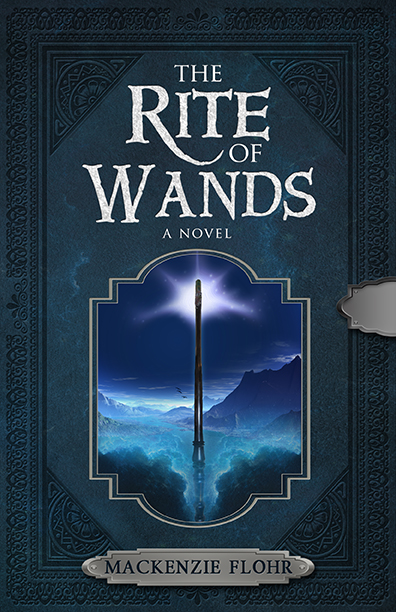
In The Rite of Wands, author Mackenzie Flohr has created a fantasy world of witches and warlocks set in 13th century Ireland. The main character Mierta, 12, has to earn his magic powers.
“It took me 20 years to write this,” said Flohr. “I realized that I have a dead book.”
But then the new character, originally Gerard, spoke to Flohr and said, “That’s not how it happened.”
Protagonist Mierta too is a neurodivergent like the author. Flohr used an entire disease layer in the story that reminded people of Covid, although the story was completed in 2017. Much like the black plague, she gave the disease a physical appearance.
The book was inspired by The Lord of The Rings trilogy, as Flohr visited a museum dedicated to the movie series.
“And there was my story,” she said. “Mierta goes, we’re going to tell that story.”
Every character in the book has three layers to them.
“They all fit together at the end,” she said. “There is a little bit of myself in both protagonists. I got the wizard language right.”
Flohr is working toward TV series adaption of The Rite of Wands. Listen in for a chance to with an autographed copy.
Victor Volkman is the publisher of the U.P. Reader, senior editor at Modern History Press based in Ann Arbor, and president of the Upper Peninsula Publishers and Authors Association.
The U.P. Reader is the brainchild of author Mikel Classen. Volkman said he can’t be a Yooper because Yoopers are born, not made. The hefty publication features thirty to 50 contributing writers, most are members of the UPPAA.
“People who live in the U.P are great writers, the U.P. Reader exposes their writings for other people to explore,” said Volkman.
Volkman said he’s especially proud of the inclusion of Cottage Dandelion winners, young writers who receive a traveling trophy for their school, kind of like the Stanley Cup.
“We’re making the next generation of writers,” he said. “We provide training wheels for young writers. We’re able to accept 90 percent of writing.”
The all-inclusive publication, which is distributed to all the libraries in the U.P., features contemporary fiction, short stories, humor, history, memoir, poetry, and much more.
“I am a publisher, and this helped me build a relationship with writers,” he said. “We work hard to keep the price reasonable.”
Some of the highlights of the UPPAA are the spring conference in Marquette in June and the picnic on the first Saturday after Labor Day in Marquette.
Submissions for the U.P. Reader Volume 7 will be accepted until November.
“It’s a lot of fun,” he said. “I love the sense of community in the U.P.”







 authoremmapalova