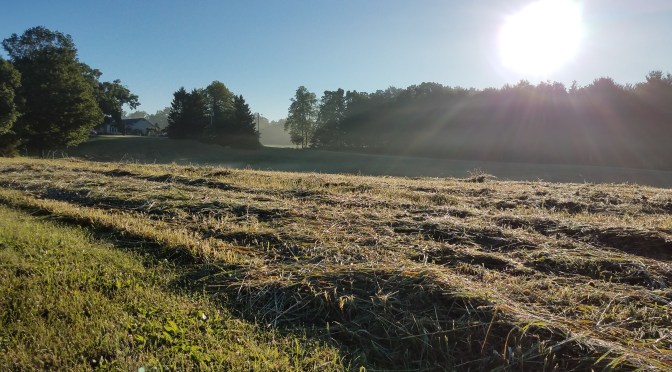
It was a foggy morning walk on the gravel road to the Sisters as August made its grand entrance on the summer scene this week.
After days of drought, the rain was forecasted at 70 percent last night. Ella called the weatherman, a douche bag. That was very appropriate, since “douche” in French means shower.
On Tuesday, I went to the Paulson’s pumpkin patch farmer’s market north of our ranch. I bought our favorites, peaches and plums for the classical Czech summer fruit dumplings dish topped with cottage cheese.
I had to pass on the first harvest of cucumbers, since we will not have the time to can them this year. But we do have a good stock of last year’s sweet and sour pickles to get us through the winter.
Purple blue plums are also the main ingredient in plum brandy, known as “slivovice.” I call plum brandy, the Moravian gold.
It looks like an abundant harvest this year.
Czech fruit dumplings with cottage cheese
The Paulson’s farmer’s stand overlooks the vast fields of vegetables, fruits and orchards that were wilting in the heat, along with some marigolds by the fence.
“Did you do the rain dance?” asked me the owner sitting comfortably in an orange folding chair behind the counter loaded with fresh produce.
Among the novelties at the stand were sweet jalapenos. I have yet to try them. But, I did buy yellow cauliflower and red lettuce for different color varietals.
“No, should I?” I asked.
“You should do it every morning,” he said.
Then, I remembered while watering the patio garden, I did run a stream of water on my brand new mysterious “rain chain” and on the tin sunflower, causing it to whirl.
And it finally rained, this morning after I dropped off Ella at the summer school. I went to my favorite hideout, and it poured on the lake. I watched the rain swirl and twirl on the windshield.
But, before that, being totally stripped of any energy, I ate the entire Chocolove xoxox Almonds & Sea Salt dark chocolate bar. It tasted like heaven, after weeks of starving myself for the book signings.
To my great delight, I discovered inside the chocolate wrap a poem by Alexander Pushkin:
Thou and You
She substituted, by a chance,
For empty ‘you’- the gentle ‘thou.’
And all my happy dreams, at once,
In loving heart again resound.
In bliss and silence do I stay,
Unable to maintain my role:
‘Oh, how sweet you are!’ I say-
‘How I love thee!’ says my soul.
It’s going to be a great August.
I am looking forward to the Czech Harvest Festival this Sunday in Bannister. Watch for post.
It’s no ordinary Friday, as the late July sun shines on my new book Shifting Sands Short Stories. The paperback came out at the beginning of July.
Writing, collecting and publishing the stories that I have gathered for over more that two decades wasn’t a walk through the strawberry fields by any means.
On the contrary, the stories and their characters are not Shallow.
Check out one of the major characters, professor Martin Duggan who struggles with his own perfection.
Excerpt from the Temptation of Martin Duggan short story:
“He walked to his gray Chevrolet, the only brand he trusted over the years. Just like everything else Martin had ever owned, it was perfectly clean. He didn’t forget to grab a bottle of cold diet Coke from the machine.
Driving through Rocky Rapids was a balsam on his nerves. The town was neat and clean too with a few banks, a video store, a car dealership and a long gone Spartan grocery store.
Rose used to shop there, when they still loaded groceries into cars back in the 1980s. As a remnant of the past, there was a Bear furniture store, a drive up restaurant and a Dairy Queen by the city park and creek.
It could have been a perfect day, in a perfect life in a perfect town of one perfect professor and a perfect couple.”
At one of my newspaper jobs, the publisher called me shallow for not following up on a major story about a Belding boy who delivered his sister in the bathroom of the family home. After being syndicated by the Associated Press, the story made it to the Dave Letterman Show.
Dave held up the front page of the Ionia Sentinel-Standard with the story.
However, I did not know about that, another paper reported on that.
“You are shallow and selfish,” said the publisher.
Local author pens Shifting Sands book of short stories
A press release is a TraditionalGate way to media coverage at large, don’t be a Dormant writer,or author. You’ve finished your book now what?
For immediate release
July 25, 2017
Contact info
Emma Palova
phone
email
website
Lowell, MI- Local author Emma Palova of Lowell has published the book Shifting Sands Short Stories, formats kindle and paperback, now available on Amazon for $7.99 and $11.99.
Palova’s book will also be available at the Kent District (KDL) libraries, the Hastings Public Library and in Big Rapids.
She will have a book signing event at the Fallasburg one-room schoolhouse museum on September 16 & 17 from 1 p.m. to 4 p.m. during the Fallasburg Fall Fest and the Fallasburg village bazaar, with more local author events to be announced. The public is welcome.
Tell us your story.
The Shifting Sands Short Stories book is a collection of 13 short stories that Palova wrote and collected over the span of more than two decades. The fiction’s genre is magic realism, a combination of fantasy with reality.
“In magic realism you combine the fictitious with fantasy and sometimes you use real characters to model the fictitious characters,” Palova said. “It can be a hybrid. I don’t write about Martians. I write about real people.”
Palova started writing for the Czechoslovak Newsweek based in New York City in 1990 upon arrival in the USA. She initially wrote a column, “A Place for Commentary” in Czech.
Many of the stories are based on experiences Palova has had during her time living and working in the greater Lowell area, West Michigan.
“I am passionate about the hometowns in Midwest America their characters and personalities,” she said. “They are a hardy bunch.”
Palova has been writing for the area publications since 1997 when she launched her journalistic career with Kaechele Publications in Allegan. In 1998, she joined the staff of the Ionia-Sentinel Standard where she received awards for community reporting from the Ionia Chamber of Commerce in 2000 and the Ionia County Community Mental Health, 2003. In 2011, she received an award from American Legion for covering veterans’ events. In 2015, Palova also had a community blog in the Ionia Sentinel-Standard.
Palova worked as a correspondent for the Grand Rapids Press, the Advance Newspapers, Gemini Publications and the Lowell Ledger.
Palova is currently working on the second volume of stories, as well as on the memoir “Greenwich Meridian, where East meets West” about the Konecny family immigration saga from Czechoslovakia to the USA.
She is preparing her first novel, “Fire on Water” based on her communist experience for publication.
Palova has a lifetime passion for history and politics. She does social media marketing for the Fallasburg Historical Society (FHS), and she is working with the Tri-River Historical Museum Network.
“I am deeply humbled by the opportunities this country has given me,” Palova said.
Shifting Sands Short Stories on Amazon, author’s page
In this series following the release of the Shifting Sands Short Stories collection, I answer questions about the stories, characters, me and my writing career.
By Emma Palova
I’ve been on the other side of an interview only twice in my life. That is if I don’t count job interviews. As a reporter, I’ve interviewed thousands of people for newspaper and magazine stories over the years. I’ve always been very comfortable at asking questions, in person or over the phone.
The subject didn’t really matter, unless it was a personal issue of officials resigning under duress.
Recently, Tim McAllister interviewed me for the local paper the Lowell Ledger about the Shifting Sands Short Stories book release. I wrote for the paper for many years as the lead reporter. The article “Ledger reporter pens book of short stories” came out on July 5.
It was a great interview that resulted in a great story. And I am grateful for that. Thank you.
An interview is like a Bridge to a destination. A good interview is a firm bridge to a good story with a firm foundation. It is a lot like the physical structure that connects two places.
Here is a picture of one of my favorite bridges, and that is the Fallasburg Covered Bridge built in 1871. It has been connecting people with the Fallasburg pioneer village for the last 146 years.
And because everything is connected, my book signing on July 16 from 1 p.m. to 4 p.m. will be held at the Fallasburg one-room schoolhouse museum. Everyone is invited into the historic setting, that well fits the premise of the short stories set in hometown Midwest America.
The only other time I was interviewed was when I became an USA citizen in 1999 in a naturalization ceremony at the Gerald Ford Museum, along with my daughter Doc Emma.
And now I have found out that I am equally comfortable on the other side of the interview. That is answering questions about my new book Shifting Sands Short Stories, me and my writing career.
I love the interaction with my followers, friends and family.
Just yesterday, I got this question:
“What is your favorite story in the book?” asked my daughter-in-law Maranda.
I love this question. I used to ask artists the same thing.
“What is your favorite painting?”
I use the analogy of releasing the book to releasing your child into the world, after he or she graduates. You nurture them or the book idea for years. Then you work it into a book, and release it to the world.
“You’re kind of sad, and it’s also a highly emotional situation that you did everything you could possibly do,” I said.
The entire world around the publication of the book is different from anything else. I had to write it down on a piece of paper:
“Don’t treat this like everything else you’ve done in life, because it’s different.”
The difference is mainly in the novelty and the complexity of the entire publication process from the inception of the idea to holding the actual book in your hands.
“I got shivers for you when we got your book in the mail,” said Maranda.
In between story circles, a story of transformation with excerpts
For the last week since June 20, I’ve been posting about the stories in Shifting Sands Short Stories collection that span more than two decades as part of the Storyteller 2017 book campaign.
Thematically and chronologically, I have divided the stories into three circles: early years of immigration with stories Danillo, Honey Azrael, & The Temptation of Martin Duggan.
Storyteller 2017 Emma
The second circle of stories from retail experience includes: Tonight on Main, Therese’s Mind, Boxcutter Amy, Orange Nights and the Death Song.
The third circle of stories is from the media business; both print and digital.
These stories include: In the Shadows, Iron Horse, Foxy, Riddleyville Clowns and Chatamal.
Transformation during the crisis of mid-2000s
My husband Ludek left the state of Michigan to work in Wisconsin in 2008-2009. We were separated by Lake Michigan, and 500 miles deep into the Midwest America. Locals say that Wild West begins in Prairie-du-Chien on the Mississippi River, where Pere Marquette and Joliett arrived. On a few occasions, I took the Amtrak train “Empire Builder” to LaCrosse to visit with him.
At the time, I was writing for the local newspaper and for regional magazines in the Grand Rapids area. But, that wasn’t enough to make me forget the absurdity of the situation. This was the second time in life that we were separated.
I turned to more writing like a Magnet. I got the idea to write the “Riddleyville Clowns,” a short story from a hometown parade featuring clowns to celebrate the town’s founding anniversary.
I wrote some of the copy aboard the “Empire Builder” train.
Here is an excerpt from the “Riddleyville Clowns”
The harvest moon has just started to light up the entire loft apartment on Main Street. The brick walls softened with blue shades, the pressed tin ceiling was illuminated, while the river was like a silver thread lined with black banks.
Still resisting to get up and go check out the old steamboat, Kip tossed in bed watching the ceiling. He looked up at one of the walls.
Flabby blue pants, a yellow camisole, wide red band and a big red plastic nose topped off with a wig were hanging in the corner. Down below were big red shoes with a tongue sticking out and large-fingered gloves.
Kip walked to the window. Below, a large flock of geese and ducks, had buried their heads deep to sleep. He could hear them fighting over bread thrown down from of the other lofts. Kip walked to the boat.
The old white steamboat known by the locals as the Showboat, all decked out for tomorrow, was swaying in the wind and the water. Swinging over the white railing, he checked out the shaft by the stairway leading all the way to the upper deck. It was dusty, but he could see the lid that opened up on the deck.
Kip quickly attached a rope to a rusty hook. He also had to cut out a plank at each deck level to make the shaft passable. He noticed on the walls of the shaft old posters of vaudeville acts that took place on the boat in the depression era.
Kip climbed up and opened the lid right behind the ship’s black chimney. In the moonlight, he could also spot a dilapidated amphitheater with grass growing over the sea walls and the island of cattails up the stream. Wind howled again through the river corridor. Kip wrapped his wind jacket tight around him and gazed toward Main Street. A tribune was set up right by the Riverwalk promenade for tomorrow’s parade.
For the last week, I’ve been posting about the short stories in Shifting Sands Short Stories collection that span more than two decades as part of the Storyteller 2017 book campaign.
Storyteller 2017 Emma
Thematically and chronologically, I have divided them into three circles: early years of immigration with stories Danillo, Honey Azrael, & The Temptation of Martin Duggan.
The second circle of stories from retail experience includes: Tonight on Main, Therese’s Mind, Boxcutter Amy, Orange Nights and the Death Song.
The third circle of stories is from the media business; both print and digital.
These stories include: In the Shadows, Iron Horse, Foxy, Riddleyville Clowns and Chatamal.
In the final countdown, I would like to touch on stories like “In the Shadows” that fall into a dark period of life. Husband Ludek lost his job in the mid-2000s due to crisis in the automotive and housing industry.
The story was inspired by us living apart, when Ludek had to take a job in Prairie-du-Chien, WI.
Ludek and I had to Cringe confronting the reality of the crisis.
We didn’t want to lose the house, because of the unsure future, so I stayed in Michigan.
On several occasions, I took the Amtrak train 500 miles out west to visit with him on the Mississippi River, or we stayed in Milwaukee.
“In the Shadows” story is set in Milwaukee and in the botanical gardens. It was inspired by a wedding party in the gardens.
The characters lived in the state of impermanence Transient
Excerpts from “In the Shadows”
With a shaking had speckled by age spots, Agnes Loire dressed in pink and white purchased three tickets to the Boehm Botanical Gardens near Bales Corners in Wisconsin. An elderly clerk taped a red band to her tiny wrinkly arthritic wrist refusing to give her a discount.
As Agnes reached into her pocket to feel an amulet with dried periwinkle in it, the clerk looked somewhat familiar.
“Do I know you from anywhere?” she asked the old man.
He shook his head and turned back to his business of taping red bands to people’s wrists standing in a long line in the glass atrium.
Just before Agnes entered the new modern building with a two-story atrium and a vaulted ceiling, she paused to watch a white limousine arrive. The morning sun illuminated the vehicle and the grounds. The internationally renowned gardens were a marrying haven for couples.
The flowering pink, white and maroon crabapples in the arboretum swayed in the southerly wind spraying the area with petals of blossoms.
Agnes breathed in the early spring scent, fresh with promises.
In the meantime, the photographers had eagerly gathered to take the first shots of the bridal party. Bridesmaids in bright green dresses and beige high heels stepped out of the limo.
The last girl was taller, her dress a tone lighter and she was wearing flat shoes with no heels.
There is no Reprieve from writing. Call it passion, obsession or both.
The writing demons in my head woke me up early in the morning, somewhere between the night and the day.
The persistent insomnia caused by the flow of ideas perpetuates itself from day into the night and vice versa. It is a dream come true for any writer; that is fluent writing time without blocks.
It is especially important now as I am moving into the publishing finale of my “Shifting Sands Short Stories.”
It is in this quiet time without outside disturbing energies, that I manage to write the most. Plus, I have the rest of the day to reflect on the morning production to improve it and carry it forward.
Just to illustrate how early this morning’s start was is that when I checked the Daily Post prompt for today @reprieve around 6 or 7 a.m. there were no responses yet. As I write this some five hours later, there were 64 interpretations of the “reprieve” prompt.
I find the reprieve theme very fitting before the Memorial Day long weekend. It will be a good quality time spent grilling, gardening and at my favorite spot on Murray Lake.
On Monday, I like to go to the Memorial Day parade in Lowell to honor the veterans at the Oakwood Cemetery.
Sexton Don DeJong makes the cemetery a place to observe history with his historical cemetery walks. DeJong has compiled the cemetery info into several books over the years. Watch for more stories.
Boating on Murray Lake in Michigan.
I am grateful for this much-needed time off for all of us to restart again.
Lowell, MI – I was born with history in my blood in the wee hours on Victory Day, May 9th to the cracking of the fireworks and the fragrance of the blossoming lilacs.
Before the semantics & politics of the new regime, May 9th was the national holiday in my homeland of Czech Republic.
Every year, on this day, my mother Ella lovingly says this sentence:
“I thought they were bombing, but the country was celebrating your birthday. The entire earth blossoms for you.”
Emma in Manistee National Forest north of Baldwin, morel hunting on May 6.
Now, my mom Ella is not exactly the most humble person. She loves to show off. She takes that after Grandpa Joseph of Vizovice.
Annually, the country celebrates the anniversary of its freedom from the Nazi occupation in 1945. The holiday has been moved to May 8th based on the age-old dispute, “Who was first, the chicken or the egg?” That is the dispute over which army freed former Czechoslovakia first.
Was it the Soviet or the American army?
The Soviets freed the capital Prague on May 9th, while the Americans freed Plzen in West Bohemia on May 8th. Maybe, the switch was due to the fact that Plzen is home to the famous brewery, Pilsner.
The country boasts its love for beer, and often takes first place in consumption between the top beer consuming trio of Germany, the Netherlands and the Czech Republic.
However, in our immigration hearts, the holiday will always be on May 9th, even though we love Czech Pilsner.
So, by default, the love for history has been circulating in my blood from the first day of birth.
Our immigration Konecny saga started with the infamous occupation of the country by the Soviets in the Prague Spring of 1968. The era of hardline communism ensued after the invasion for decades to come under President Gustav Husak.
I am also the child of the 1989 Velvet Revolution led by my hero, late president Vaclav Havel who was part of the Prague Spring 1968 reformation movement.
I can trace the origins of my writing to that tumultuous time in our lives.
My paternal grandpa Antonin was the keeper of the “Chronicles of the Stipa JZD” which was the Stipa Agricultural Cooperative, while my late Aunt Martha secretly worked on the Konecny family genealogy. My grandma Anezka was a first grade teacher at ZDS Stipa and a poet.
“You can’t deny genes,” said Martha’s colleague Mrs. Fickova at the funeral wake on Jan. 11th held at the Stipa Senk.
After Aunt Martha’s death on January 7th, 2017, I started the Facebook page Ancestry Konecny on:
As an author, writer, journalist and photographer, I keep track of happenings on daily basis in my physical and digital diaries. I also do that for other people on the WordPress portfolio.
My May 9th morning started with Google Doodle wishing a happy birthday.
Every morning before I start writing, I check social media for inspiration and to get a feeling for the day.
I made me a cup of French Roast coffee and smelled the bouquet of lilacs from our gardens on the ranch. It took 20 years for the fragrant shrubs to come to their full beauty. Not quite like the historical ones on my beloved Mackinac Island, but they’re getting there.
Yesterday, my husband Ludek and I feared for the budding wisteria because of the early morning frost. We had to put out the fan to keep the wisteria, sprawling on the octagon pergola, warm.
Then, as always I gather my thoughts based on analyzing the previous day, and what I have learned from it, that is worth bringing into the future. I always remember the socialist propaganda, “Tomorrow is already yesterday.”
I pinned to the top, “Spring into the Past” museum tour 2017 organized by the Tri-River Historical Museum Network on the new museum page.
I also made sure that the 23rd annual Covered Bridge Bike Tour in Fallasburg is correctly dated for Sunday July 9th.
I looked in the mirror, after finishing most of this post, and I realized I am very fortunate, and that any victory comes at a price. I’ve come to that conclusion not from the image that I see, but by the person I reflect in my writings.
I have a head full of graying hair, a happy smile on my face, a caring husband and family, hundreds of fans and well-wishers from all over the world, and the determination of a Taurus.
My short story collection “Shifting Sands” is ready for June 1st publication on kindle and Amazon.
And speaking about karma or karmic energy.
My friends from the Fallasburg Historical Society (FHS) Tina Siciliano Cadwallader and Tracy Worthington are planning a book signing event for the “Shifting Sands” fiction short story collection at the Fallasburg one-room schoolhouse museum on June 25th from 1 p.m. to 4 p.m.
I’ve just found out that mom Ella is going to bake a cake for the book signing. And I have received tulips and irises from Doc Em, based in Fixin, France, and a video from Josephine & Dominik Pala of Hastings.
Life is good. As Doc Em says:
“What doesn’t kill you, makes you stronger.”
Everyone is invited to Fallasburg on June 25. Come and enjoy the beautiful Fallasburg Park, the pioneer village, the history and mom’s cake.
With this post, I would like to thank everyone for all the support over the years, especially my neighbor Catherine. Because only Catherine knows who I really am.
Note: Tthe Inspiring Communities series features men and women who inspire us in our communities to help other people achieve well-being in an increasingly complex world. Nominate a person who has inspired you.
Arctic Heating & Cooling owner Evert Bek
Local businessman helps install water filters on Haiti, where water is the Elixir of life
By Emma Palova
EW Emma’s Writings
Lowell, MI- At the best, a running water system on the forgotten island of La Gonave off Haiti consists of a cistern tipped upside down with a hose that leads through the window inside a hut.
However, most often you will see a container full of dirty rain water known as the municipal well. The villagers haul water in buckets on donkeys or on their heads.
Usually when tested, the water is full of coliform bacteria, which causes cholera, according to Lowell resident and business owner Evert Bek.
Bek was part of a team that installed water filters in Haiti at the beginning of March. The project was spearheaded by the Lowell Rotary Club.
“There is no running water on the island,” said Evert. “There is no electricity, no bathrooms, people live in huts. They use rainwater collected in cisterns.”
The team installed 80 water filters which are cones filled with sand and stones from the local sources. Each dwelling paid 35 cents per water filter.
It takes 10 gallons of water to get the filters started before using as safe water supply, according to Bek.
Bek was astonished at the living conditions on Haiti, located only 709 miles from Miami. Most recently, Haiti was hit by hurricane Matthew on Oct. 4, 2016, and the country still suffers in the aftermath of the devastating earthquake in 2010.
A typical dwelling is made of cement, it has a dirt floor, one room. And it accommodates anywhere from two to 10 people.
During the week-long stay, Evert said, he only saw meals cooking outside twice.
“One day we had beans and rice, the next day we had rice and beans,” he said. “The laundry is done outside by hand.”
Usually, the huts are scattered all around with a church as the center point. The team stayed in the village of Pikmi.
“We had to have a translator,” said Bek.
The island, which has no industry, was conquered by the French in the 1600s. The official language is Creole, which is a French African dialect.Their guide and translator was a self-taught man, who called himself Day Day. People use small motorcycles as transportation, but they mainly walk. It is not uncommon to see three to four people riding a motorcycle.Old pick-up trucks are left wherever, when they stop working.
The land is just clay and rock, because the top soil eroded as the forests were harvested unlike in the neighboring Dominican Republic.
“The island sits on a bare rock,” said Evert.
Approximately 100,000 people live on 287 square miles.
Weekly, there is a village market, where animals are traded. Charcoal on the island is used as a cooking fuel. However, there are no tools to fix anything.
In contrast to the overall living conditions, the population wears discarded t-shirts bearing losing sports teams’ logos, peddled by different organizations from the USA.
Kids and adults walk around with non-working phones.
“It’s a status symbol,” said Evert. “There is a lot of corruption in the country, you got to be ready to get your valet out to get anything done.”
Churches have done a lot of work on the island in schools and education. Kids go to schools in uniforms, and there are orphanages in good condition.
According to Evert, the big unknown remains the economy on the island even once the water problem is solved.
“You have water and then what?” he said.
There are a lot of unfinished houses on the island due to lack of materials and finances, and corruption.
A typical banker sits outside with a duffle bag of money on the corner of gravel streets. He holds dollars in one hand and Haitian Gourdes in the other hand.
If you go into a “store,” you will not get any change back.
“I learned the hard way,” laughed Bek.
The team stayed in a guest house with water and kitchen, leased through an organization based in Saranac.
“I like to help out,” he said. “Be grateful for what you have.”
Featured photo is of a Wednesday market on the Haitian island of La Gonave.
If you want to help contact your local organizations. This water filter installing project was through the Lowell Rotary club at http://www.lowellrotary.og
This post was also written as a response to the Daily Post prompt @elixir Elixir
Lowell, MI- It’s 5:53 a.m. EST on a regular Thursday morning. Husband Ludek just left for work coughing, and I am recovering from a bout of cold that kept me inside yesterday. It’s still dark outside, and I light some candles, so I can meditate before writing with a cup of coffee, and a cup of nettle tea.
But, something else kept me indoors yesterday, as well as in my own shell. I was dealing with a red fury, called anger that topped off with an apple that my husband didn’t take to work with him. I always get an apple ready for him thinking about his health in the morning.
Rhythmic changes of nature withour our contribution, a sunset in South Haven, Michigan.
When the apple was still there yesterday, I thought he was angry at me.
I felt the anger building up in me since Monday, as I watched the disturbing evening NBC newscast on “Tonight at 7.”
“I’ll never forget this one,” I said disgusted to Ludek. “I won’t sleep again.”
It was a slew of everything from my 1970s teen idol David Cassidy’s announcement of dementia, to the one year anniversary of the Uber shooting in Kalamazoo, Michigan, that left six dead and two wounded.
“We don’t want Kalamazoo to be remembered for this,” said the speaker at the Monday night vigil held at the K-Wings Stadium teary eyed.
The newscast showed Laurie Smith, wife and a mother, who’s loved ones where shot on that dreadful night at a car dealership, shopping for a truck. The daughter was supposed to go too. She didn’t. That saved her life.
Laurie held little urns with ashes as dreadful charms tied to a necklace in her fingers, crying.
“I carry their ashes around my neck,” she sobbed.
How can you not remember this? I would have to be a piece of stone.
All the colored beads representing different emotions.
Kalamazoo is home to one of the best universities in the country, the Western University Michigan (WMU). Other than being the home of the Broncos, it is the alma mater of many and an intellectual oasis in Midwest America.
My son Jake went to Western. He graduated in winter of 2010 in an auditorium decked out with red and white Poinsettia plants in pots with glittery wrap around Christmas time.
Surreal.
Early on when we settled down in the Grand Rapids area in the 1990s, I took online classes in psychology from WMU. I love the entire university environment along with the culture, the libraries, the ethnic restaurants, the university cafeterias and the sports. My parents worked at Ferris State University in Big Rapids until retirement in the 2000s. I studied at the Technical University of Brno, my dauther Doc Em studied at Charles University in Prague.
We have university blood circling in our veins.
I celebrated one of my birthdays at the WMU Performance Arts Center with the longest standing performance of all times, the “Phantom of the Opera” in 2007.
“Can you imagine those actors doing it over and over again?” said my friend Sue, when I complained to her that every day at the newspaper office was the same.
Many years later, as I think about all these moments, like grains of sand, sifting through time in an hour glass. The little sand grains that represent anger, fear, terror, joy, love and hope in a cyclical rhythm.
Grains of time sift through the hour glass rhythmically. To the right: my parents Ella & Vaclav Konecny with grandpa Joseph Drabek in 1987 during grandpa’s only visit to the USA.
Below is a photo essay representing the victory of joy & hope over rhythmic violence: left 1001 Days of Blogging Annie Conboy of UK who blogs for the future of her daughter Erin. Right top: son Jake Pala who teaches Josephine Marie Palova, 3, the Czech language to preserve our origins. Below right in the small frame, French granddaughter Ella, 6, on summer break in Parnell to learn English. Pictured in the bottom frame is Mrs. Irma Richmond, teacher from the one-room schoolhouse at Fallasburg in the 1960s. Today, kids from Murray Lake Elementary and on the http://www.fallasburgtoday.org come to visit the school thanks to the advancement of technology. Mrs. Richmond says hi to all.
Follow Mrs. Richmond’s and Annie’s stories into the future.
Fallasburg one-room schoolhouse teacher Mrs. Irma Richmond, 1927-28, 1944-45. Today students from the Murray Lake Elementary visit the 1867 Fallasburg School located in Vergennes Township.
Before that lovely opera performance, we enjoyed a meal at Rasa Ria, a Malaysian restaurant with my parents Ella and Vaclav in downtown Kazoo.
It was one of my best birthday celebrations, ever. And it was in Kalamazoo, in the university city of intellect and terror.
And now this additional piece of terror, that will always stay in our minds, and in those charms with ashes around Laurie’s neck.
I can still recall the actual coverage of the Uber shooting one year ago, when the police contained the rampage in 4 hours and 42 minutes. The footage showed cars chasing the suspect, finding the victims at innocent places like Cracker Barrel and at the Seeley dealership in Kalamazoo.
“Why did he do it?” Ludek kept asking me.
The news report mentioned that the Uber driver said that the devil told him which people to shoot through the phone app.
“Crazy?” I ask.
One year later, crime perpetrator, Jason Brian Dalton, 45, still hasn’t been convicted. A hearing is set for March 9. If convicted, he faces a life in jail, according to news reports.
As I watched the vigil for the victims, my memory flashed back to a trip to France in 2016 with our granddaughter Ella. We were waiting for a Uber driver to take us from Charles De Gaulle (CDG) Airport to Gare du Nord train station in Paris.
“Emma, are you sure this is safe, you know about that shooting in Kalamazoo?” I asked my liberal daughter Doc Emma, who permanently resides in the wine village of Fixin, in Burgundy France.
“Oh, it can’t happen here,” she said, “only in America.”
“Really?” I asked.
I thought about all the violence of the past two years in France as it flashed through my mind; from attacks in Paris, Nice and Belgium.
Now, back again to the current reality as of Feb. 23, 2017. The two Uber shooting survivors, Addie Kopf, 15, and Tiana Carruthers, 26, continue to fight forward.
After undergoing several surgeries, Kopf has difficulty speaking and remembering, in spite of overall improvements. Carruthers, who shielded children from the gunfire, is now walking without a cane, according to news reports.
I glanced at the comments following some of the broadcasts of the one-year anniversary of the Uber shooting that occurred in Kalamazoo on Feb. 20, 2016.
robandhan1 day ago
Huh… another white guy with a gun…
jime4441 day ago
@robandhan and how many die in chicongo each day? not many white people, either………libturd.
charlie251 day ago
Does anyone remember this??? There have been so many weirdos killing people in the past year to remember this one.










 authoremmapalova