
A sample chapter from Greenwich Meridian Memoir
The 1968 Prague Spring was looming over Czechoslovakia. On the night of August 20th, the country was invaded by the Soviet tanks and the armies of the Warsaw Pact. Hundreds of tanks roared all over the country in the full-blown invasion that impacted an entire generation of immigrants to the U.S., Germany, Canada and Australia. The country was occupied, and the Russians set up military bases both in Slovakia and in the Czech region. The Russians punished the Czechoslovak liberal government for attempting to create “socialism with human face.” The reformist movement was led by Alexander Dubcek, and late president Vaclav Havel who was part of a signatory group called Charta 1968. The Charta group proposed a series of reforms that meant to ease restrictions on the media, free speech and travel.
At the time of the occupation, my mother was on a spa stay in Carlsbad in Western Bohemia, a famous town known for its 12 healing springs.
“I went to the colonnade in the morning,” mom said. “People were crying, listening to the radio. There were huge demonstrations, as people knocked down statues of the communist leaders.”
Mom had to stay three more days, because the roads were closed due to tanks. Then she took a detour bus through Sumava to Brno.
“We had a new apartment in Brno, but I left for Vizovice to be with my parents,” she said.
There was no telephone connection, according to mom. But the borders were open for anyone to leave freely.
“My friends were leaving the country, crossing the border on foot with just a suitcase in their hands,” she said. “I didn’t want to go anywhere.”
She left by herself on Sept. 28, 1968 for Africa leaving us behind with grandparents Anna and Joseph.
I learned this from horror stories, passed down from generation to generation, and from an interview conducted with my parents in Venice, Florida on March 5th 2013.
My parents came back to Czechoslovakia in 1969 to be reunited with us and the rest of the family for a brief moment in time. Dad left again, because the school year in Khartoum was beginning.
“I didn’t want to leave. We just wanted to save some money for a house in Brno,” mom said.
But, as the one-year anniversary of the occupation approached, mom packed up her belongings along with us. All three of us ended up in Vienna, Austria with the help of a friend from Vizovice, and flew back to Africa. Since the exit visa was extended until the end of 1970, mom was still hoping to return to Czechoslovakia.
“For two years I lived in a limbo,” she said not knowing what was going to happen.
But dad was determined not to return to the Soviet-occupied country.
“We were discussing it with colleagues,” he said. “We had a consensus that we were not going to return.”
So, that’s how all four of us finally ended up together as a family in the fall of 1969 in Khartoum, Africa.
Relatives advised my parents not to return back to the country which was going through “normalization,” a hardline communist approach that purged all of Dubcek’s reforms. My heartbroken mother was crying constantly after dad said he wasn’t going to return home. So was my Grandmother Anna back in the old country. Total chaos prevailed, both inside the country and outside. People were leaving the country massively anyway they could, on foot or hidden in trunks of cars.
“Do not come back,” warned my paternal Grandfather Anthony in letters describing the grim situation in the homeland.
My Uncle John too was ready to leave the country, but Aunt Anna refused to. The border with neighboring West Germany was heavily guarded. Whoever got caught crossing was shot on the spot mercilessly. Everything was censored: letters, newspapers, TV, movies, as the Communist Party tightened its grip. Phones and apartments of suspicious individuals were tapped, that is if the residents were lucky enough and didn’t get locked up in jails. But so many did, like former president Vaclav Havel. The party put a damper on arts and culture allowing only the works of “socialist realism” about the working class called “proletariat.”
There was no TV in Khartoum at the time, so dad relied on British radio BBC and endless warning letters. He also listened to friends who had already immigrated to Canada. But mom still wanted to go home in spite of constant bad news. My parents fought often over the prospect of emigration. Unlike dad, mom did not speak English. She didn’t need to, because mom surrounded herself with Czech and Slovak friends. When shopping or in movies, dad translated for her. She argued that if she can’t speak English, she has to go home, and that her aging parents were getting increasingly sick.
“Do not return home,” was the overpowering message in letters coming from homeland.
Letters became a signature staple in our lives. From the origins of my name that mom saw in a novel with a letter greeting “Dear Emma” to most recent letters from Florida. In between there were hundreds of letters and postcards with stamps from Italy, Greece, Germany, Czech Republic and Czechoslovakia. I have an entire collection stored in boxes in the utility room that I call the Frankenstein Room.
It was a dark time for mom, as dad was arranging for a post-doctoral fellowship in Saskatoon, Canada with the help of a friend, Mr. Rosenberg. The airport in Khartoum was small, and people often sat or laid on the floor. We flew with Sudan Airways with a yellow tail and with Arabic letters. Sometimes we just went to the airport to watch a plane take off from the terrace. It just intensified mom’s longing for home, but helped her to reconnect. Many years later I adopted that habit of going to the airport whenever I was homesick in Grand Rapids.
My parents listened to the Beatles, and mom sported psychedelic colors and headbands typical for the late 60s, yellow and lime green. Ken was a British friend who used to visit with us. One night, he got so drunk on whiskey that he slept in the bathroom. Liquor was cheap in Sudan, who gained its independence from the British in 1956, but Britain maintained its influence and language domination.
My parents often talked about the palace revolutions during the Sudanese Civil War. I never quite understood what a palace revolution was as different governments changed hands, but it constantly inspired me. I can trace my inspiration to those days in Africa. During Ramadan, we heard the ghastly drumming coming from the other side of the Nile long into the night as the sounds carried into the river valley. I can still hear them today if I close my eyes.
Mom has always been proud of her good looks that she got from Grandfather Joseph. She had dark brown, almost black straight hair that she permed, warm brown eyes, sharp eyebrows, nice complexion and a slim figure.
“I was the most beautiful one there,” once she said about a ballroom dance.
Mom always attributed that sentence to a woman named Miluska, but I think she was actually talking about herself. Until recently, mom dyed her hair dark brown, but finally after so many years, the color would not stick. So, she reluctantly went gray. Mom has a theatrical habit of standing up from a dinner table, as she talks about the same events from her life over and over again, much like my Grandpa Joseph did.
“She always wanted an intermission during a play,” Grandpa used to laugh. He bought a miniature marionette theatre for mom and her sister Anna. As a true marionettist he pulled the strings and changed voices.
Grandpa too would stand up from the table and make Caesar-like speeches. Mom and I inherited his theatrical manners. We both love movies, and I have written a screenplay. At some point, mom started wearing her signature coral orange lipstick that goes well with her teal colored outfits.
In her early 80s, she lightens up at any mention of her fine looks and personality.
“Really?” she smiles. “I still look good, and I lost some weight.
In the African heat, mom started taking naps (siestas) after lunch. The nights cooled down considerably. We all slept in a large airy room adjacent to the living room with light green wooden furniture. The trash was deposited into a vertical shaft in the kitchen.
Mom is a good cook, as she picked up various dining customs and dishes in different countries. I should call her a “Cosmo” chef. But we all know her best for her baking. Back home she used to bake for weddings, including her own. She counteracts her baking fame with, “Where did you come up with that?” or “I hate baking.”
What she really hated was the prospect of leaving her homeland forever, even though it was inevitable considering the crisis in the country.
Dad probably made up his mind to leave the country a long time before 1968. The country has always had a shortage of apartments. He finished his studies to the screaming of my brother and hauling coal to Mrs. Vyhlidal’s deteriorated apartment in Brno, in the region of Moravia.
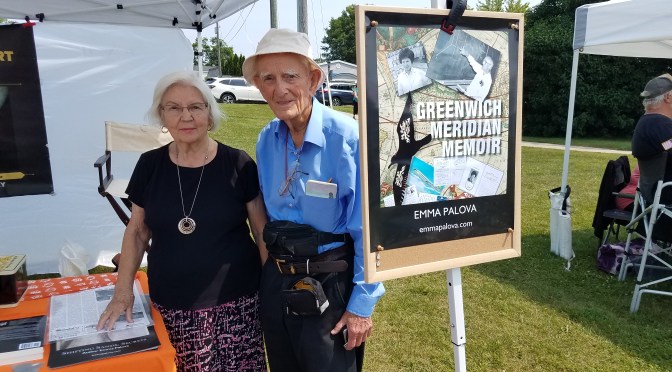
About the feature photo Then and Now
Pictured above are my parents Eliska and Vaclav Konecny who started our immigration saga from former Czechoslovakia in the aftermath of the 1968 Prague Spring. An entire exodus of several generations defected the country to pursue freedom around the world including fellow author Peter Vodenka–Journey to Freedom, Defection from Czechoslovakia.
I am humbled by the opportunities I continue to find in the USA every day. This country has not only provided freedom to three generations of Czechs, including our children, but it has enabled us to grow as entrepreneurs of @Moravian Sons Distillery.
People ask me to speak at different events about the ordeal and the obstacles we had to overcome to survive hard-line socialism. I am still on the fence about the speaking engagements, as I don’t want to politicize my Greenwich Meridian Memoir.
Last weekend, during a big book signing event at the Wild Blueberry Festival in Paradise, UP, a gentleman asked me, “What do you think about Putin and the war in Ukraine?”
“I do not give my opinion on political affairs, because I don’t want to lose 50 percent of my readers,” I answered.
I do not give my opinion on political affairs, because I don’t want to lose fifty percent of my readers.”
Emma Palova, author
It wasn’t my intention to write a thesis on either of the regimes mentioned in the memoir, that is capitalism and socialism. And I quote from the Introduction to the memoir.
“Greenwich Meridian Memoir is by no means a treatise on either of the above-mentioned regimes, then or now. We were free to return back to our homeland at any point in time during the 52 years. And we have. That is our story. Come along on a journey of a lifetime.”
If you would like a signed copy of Greenwich Meridian Memoir click on the link below:
Copyright (c) 2025. Emma Blogs, LLC. All rights reserved.




 authoremmapalova