May Day is a big day in Czech Republic. Today all the beer gardens officially open. It is also known as the day for love, as well as the entire month of
May.
It has been the subject of many poems, books & other works of art.
The most famous anthology dedicated to love in May was written by Czech poet Karel Hynek Macha.
May Day pole with ribbons in Bannister, Michigan
Copyright (c) 2014 story and photo from Bannister by Emma Palova
Gold Sunday is the first or last Sunday before Christmas which this year falls on Dec. 22nd. By then all good housewives have their baking & cleaning done according to Czech traditions. Before I started writing and blogging, I could make up to 10 different Christmas desserts including vanilla crescents, “nutty baskets” and chocolate “rohlicky.”
As a student at the prep school Gymnasium Zlin, we would even get time off for baking.
“As long as you’re keeping the tradition going,” Russian professor Chudarkova used to say.
That reminds me of the opening day of the hunting season here in Michigan where some schools get the day off. I always baked long into the night, and I filled the pastries on Christmas Eve. Back in the old Czechoslovakia I had no helpers. Many years later in the USA my son Jake assisted me by rolling out the dough from a stool.
Silver Sunday is time to get your Christmas fish for the big evening feast known as “Bountiful Eve.” The town squares in Czech Republic are home to merchants with live carp. For years during Christmases of the past I went shopping for the best carp ever sporting a net bag, so the carp can breathe.
The Christmas fish in Czech Republic is carp
Large wooden vats carried carp from ponds in Southern Bohemia. The carp trade dates back to feudalism and to the royals who granted the rights to do this. I regret that I’ve never seen the carp ponds in Bohemia.
The live carp and then the butchering of it on the morning of Dec. 24 have been the subject of stories, legends, photographs and calendars much like the day and the evening itself.
Christmas magic in Steamboat junction combines sound, light and motion
I will remember one carp story forever. One family got so attached to their live carp, they could not bring themselves to butcher it. They took the live carp to a nearby brook and released it into the shallow water. The carp probably didn’t make it, but they felt better and from then on they purchased fish filets from a well-know store in hometown Zlin and that was Rybena.
I think my uncle John butchered ours. The family usually placed the carp in a tub. One year I put the tub outside on the apartment balcony. When I went to check on the fish next day, it almost froze. I had to smash the ice and resuscitate the fish.
So, the Christmas Eve menu in Czech Republic consists of breaded fried filet of carp, potato salad, mushroom or fish soup and the great cookies.
In later years, non-carp lovers substituted the carp for salmon filets. We stick to the tradition and I buy either cod or other white meat fish. I make tons of potato salad with our own pickles.
Silver Sunday is the second Sunday before Christmas that literally makes the Christmas holiday fever rise by several degrees even though it is usually cold outside at this time of the year. It is also the third Sunday of the advent in the catholic religious year.
Outdoor Christmas markets in most European cities on major squares, are in full swing by now, and they will be open until Dec. 23rd & some on Dec. 24th. The rush is on for everything from nuts and poppy seeds for baking purposes, wooden toys and other crafts, apples and dried fruits, ornaments and keepsakes.
Christmas markets in Czech Republic. Photo by Adela Kobylikova
It’s also time to get a Christmas tree. Although back in Czech Republic most families decorated their tree on Christmas Eve, here in US our family has adapted to the custom of putting up the tree at least two weeks before the magical day. Christmas Eve is a magical day, but a lot has been lost in the translation of the feast of Adam&Eve that falls on Dec. 24th in the Czech name day calendar.
In Czech language, that magical day is called “Stedry Den” which translates exactly as Bountiful Day. Families open a bounty of presents in the evening. I will write more about the customs of that day next week as we draw closer to Christmas.
And even though, I miss deeply some of the customs in Czech Republic, I have replaced them with new ones here in USA.
This year, we totally immersed ourselves into the tradition of cutting our own Christmas tree right after Thanksgiving because three-year old Ella from France was here. We did it many years ago when kids were little at a farm somewhere in Ionia County.
Ludek & Ella cut the Palova family Christmas tree at Horrocks Nursery
I couldn’t remember where, so I looked up on Google Christmas farms in Ionia County and found Horrocks Nursery Farms just north of the city of Ionia.
We were in for probably the best tree cutting experience in my entire life.
We waited in the pole barn for a horse-drawn wagon ride by a pair of some 2,000 pound Percheron horses named Clementine & Clodis. It was a crispy sunny Saturday, as we headed out on the tree farm. No snow yet. We found the lot with Scotch pines, and cut a beautiful Palova family Christmas tree. We chatted with a friendly guy who had the shotgun seat on the wagon.
Back, in the barn, we roasted marshmallows and hot dogs in the open fire wood stove as we helped ourselves to cider, hot chocolate and coffee, while Christmas movies and music were playing in the background.
“This is great,” I said to my husband Ludek. “Next year we’ll have Josephine with us too.”
Going back to Christmas customs both here and in Europe, now is also time to send and get cards even in the era of the web. Over the 20+ years here on the American continent, I’ve received hundreds of them, but kept only a few.
One of the few precious ones, a definite keepsake, is a card from Brno with a nativity scene and a score to a Christmas carol. One of the most precious cards that I had sent out was made from a photo at the Meijer store in Cascade.
Although I can’t find it now, I remember precisely what was on it. We were picking blueberries as a family on a farm near Ludington in the 90-degree heat. We’re all holding blue pales and shielding our heads from the scorching sun with funny hats. My daughter Emma was wearing a t-shirt with a Polar bear on it.
“Happy holidays,” the card with mistletoe clip art and snowflakes said.
Speaking about passing on traits and such; both my daughter and I have the same sense for juxtaposition.
Follow me during this holiday season as I will write about Christmas traditions in the old country Czech Republic and in the new world USA.
It will be the three weeks of Christmas when the stores in Czech Republic opened their doors for three consecutive Sundays. The first one coming up Dec. 8th is known as the bronz Sunday, the next Dec. 15th is the Silver Sunday and finally the pinnacle of all is the Golden Sunday on Dec. 22nd, so follow me for some holiday magic as I will also introduce my virtual storefront page Emma’s Store.
Happy holidays.
Copyright (c) 2013 story and photos by Emma Palova
As a rule coming from journalistic background, I usually don’t write about my feelings, even though that’s what most blogs are about. But, this time I have to break that rule.
Two days ago I found a big box with Amazon fulfillment services sticker on it. I didn’t open it for a day. I do have Shop Emma’s Amazon on my blog in an effort to monetize the site along with Google translator and Adwords.
When I finally opened the big box, I found two Jedi inspired bathrobes brown, furry with white checkered sash made in China. The mysterious robes with a Star Wars tag and a big brown pocket on the right side continue to puzzle me. The box came without any invoice. Maybe it’s an early Christmas present or is there a message?
In the fast changing world of Internet where words and tags mean everything, it makes me wonder. I have been dealing lately with a lot of conflict between sisters. And that is not only between natural birth sisters, but other people’s sisters. Now, I understand why the great Russian playwright Anton Chekhov wrote Three Sisters.
“You have to let it channel, otherwise it’s not going to be any good,” he gave advise on writing.
Star Wars Jedi inspired bathrobes
I don’t have a sister, and I am glad. I used to wish I had one, that maybe we could be friends. I have witnessed hatred between sisters that goes all the way to the grave, the crib or the altar.
I write about hatred between sisters in my memoir Greenwich Meridian where East meets West. One of the sisters is my Godmother and aunt. When I visited Czech Republic in 2006, I wasn’t allowed to say hi to her. She in turn didn’t pick up the phone.
A few minutes ago, I found out somebody else’s sister ordered the bathrobes as a birthday present.
I have safely returned home after travelling around several European countries including France, Spain, Czech Republic and Switzerland.
This is the eighth installment in my adventure travel series when I decided to step back into the past to fuel my memoir “Greenwich Meridian, where East meets West.”
Lost in Brno- Czech Republic
I had one entire day on Sept. 25th to relive it all in post-revolution Brno, while my friend Jane worked her post-revolution work for an Austrian firm.
“Just follow the tram tracks into town,” she said.
Now, that was easier said than done. Brno was and is a pulsing metropolis that has cleaned itself up, so it is completely en par with Prague, Paris and Geneva. As I got into town, I found myself caught in an entire web of pedestrian zones surrounding a big park; they all seemed to lead onto Jost Boulevard.
I never heard of Jost Boulevard, and I didn’t recognize any of the huge buildings that graced it. When I asked my friend Jane about the name of the boulevard, she said it used to be Boulevard of the Freedom Defenders. I still find that fascinating the resemblance of what Alexander Dumas once wrote in reference to the French Revolution.
“The difference between patriotism and treason is only in the dates.”
Important landmark in Brno Petrov.
One of Brno’s famous fashionable promenade aka corzo is Czech Street where high-end stores are located as well a high-end restaurants. I stopped at Stopkova Pivnice for classical Czech fare, that is pork, sauerkraut and dumplings. The dish is still reasonably priced compared to the other European countries that I have visited.
Just to make sure that we could find each other, Jane and I had a rendezvous at Mc Donald’s on Svoboda’s Square. Not only did the name of that square didn’t change, it still, after all these years, served as a podium for politicians.
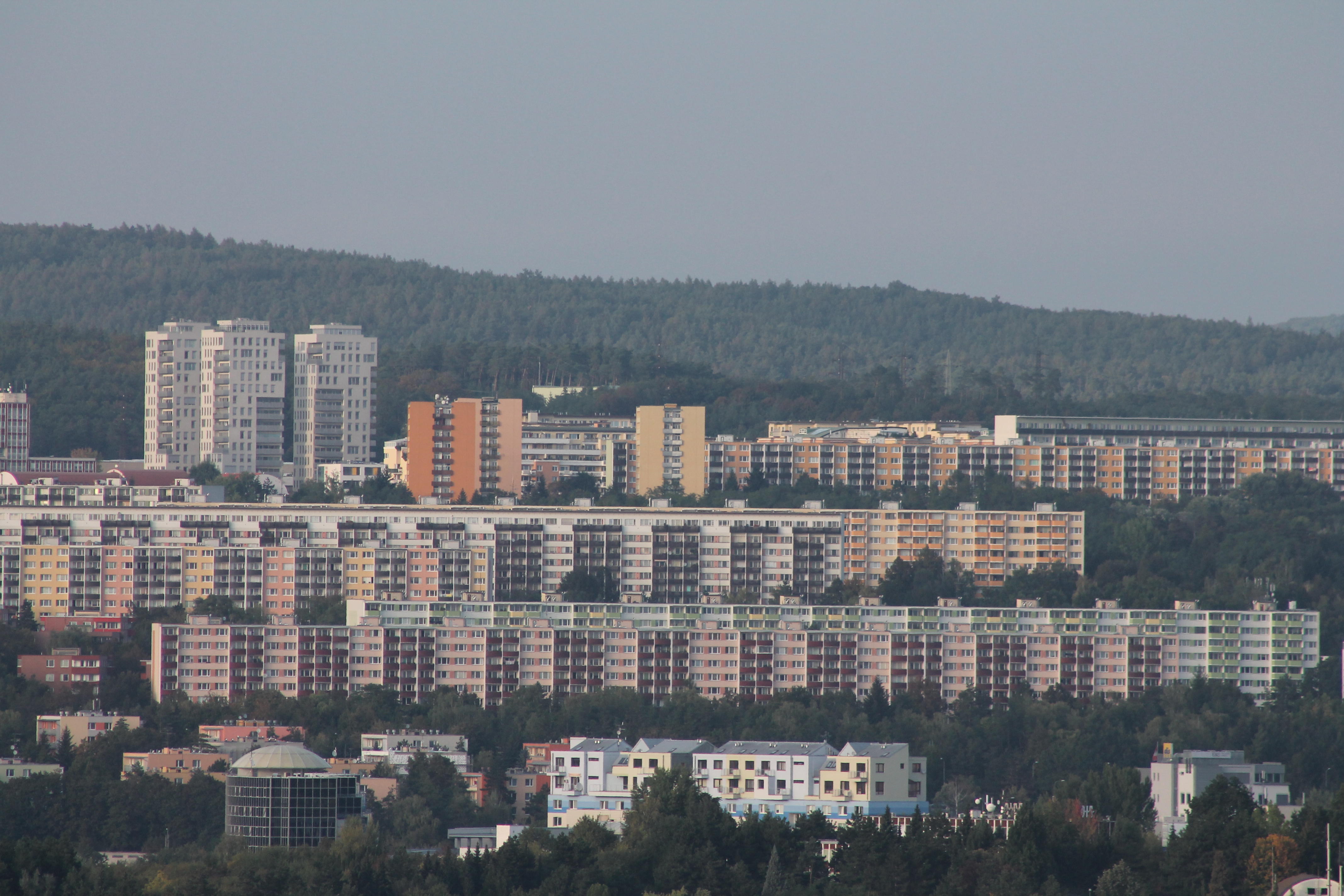
Socialist successes apartment mega complexes that surround Brno.
As I approached the square, there were police vehicles everywhere. I paused to look what was happening. Czech president Milos Zeman was giving a speech. I remember standing in similar places during the week that led up to Velvet Revolution in 1989.
Czech Republic now is part of the European Union. The country has chosen not to have the Euro currency, but accepts Euro money for historical and cultural preservation projects such as the one we visited in Brno, that is Castle Spilberg.
I marveled at the beautiful vistas from the castle. It was a perfect bird’s eye view on a beautiful sunny evening.
Jane and I looked at each other as we took in the “Great successes of socialism,” the apartment mega complexes at a distance that give living space to 50,000 people each. Brno is surrounded by them. They stand as quiet sentinels to socialist policies under which all people were entitled to work and housing.
Retro pub “U Jenika” with old beer taps.
That night, as we met up with our foreign student friend, Ismael, we raised the half-liter mugs of excellent Czech beer, that hasn’t changed its quality. We were in a retro pub “U Jenika” with old taps for beer, that was fully packed to the rafters with a band. We ordered some strong cheese called “tvaruzky” on bread with butter.
“To all the socialist successes, and we’re part of them,” we laughed.
Yes, we have lived the socialist dream that never quite fully materialized.
This is the seventh installment in my travel adventures series from France, Czech Republic, Spain and Switzerland. I started my trip out of Lansing, MI on Sept. 3rd to explore new cultures, and to venture into the past to Czech Republic.
My memoir “Greenwich Meridian” tracks our family immigration saga that now spans three generations.
Czech Republic, Brno, where it all started Sept. 24, 25, 26
On a chilly September night I got off the yellow StudentAgency bus in front of the Grand Hotel in Brno. I had my graduation party here in 1986 after completing my studies at the Technical University.
I realized that this was my first visit in almost three decades to the intellectual capital of Moravia.
Our immigration saga started right here in this University City. My dad professor Vaclav Konecny after graduating from Masaryk University with a degree in physics taught at the university and at the Technical Institute. My parents lived in an old apartment near the children’s hospital. Dad had to haul coal upstairs to heat the apartment.
“Your brother cried and cried, so we got yelled at by the landlord,” said mom.
At the same time, Africa gained independence from the British government, and was ready to start a path of its own.
Masaryk’s University in Brno.
Dad was recruited by African university officials to teach math at the University of Khartoum, better known as Harvard of Africa in 1964. He spoke fluent English, and had the desire to move ahead with his career, as well as to make decent money for a new apartment.
“I was ready for this,” he said.
Dad most certainly did move ahead when he decided not to return back to Czechoslovakia after the Soviet invasion of tanks known as Prague Spring in 1968.
“We had a consensus with colleagues that we’re not going back,” he said.
This all went through my head, as I stood in front of the Masaryk’s University that regained its name back following the Velvet Revolution in 1989.
I spent stormy four years in Brno as a student mother, a wife and a daughter of expatriated parents.
I met my best lifelong friend Eva from Kromeriz here on a train to the mandatory hops brigade. I made tons of new friends, like the one I was just going to meet after all these years, Jane. At the school, we were a strange mix of slick Brno residents, and us the so-called outsiders. As outsiders, we commuted every week to Brno, and lived at the dorms. We got along well, and complimented each other in many aspects.
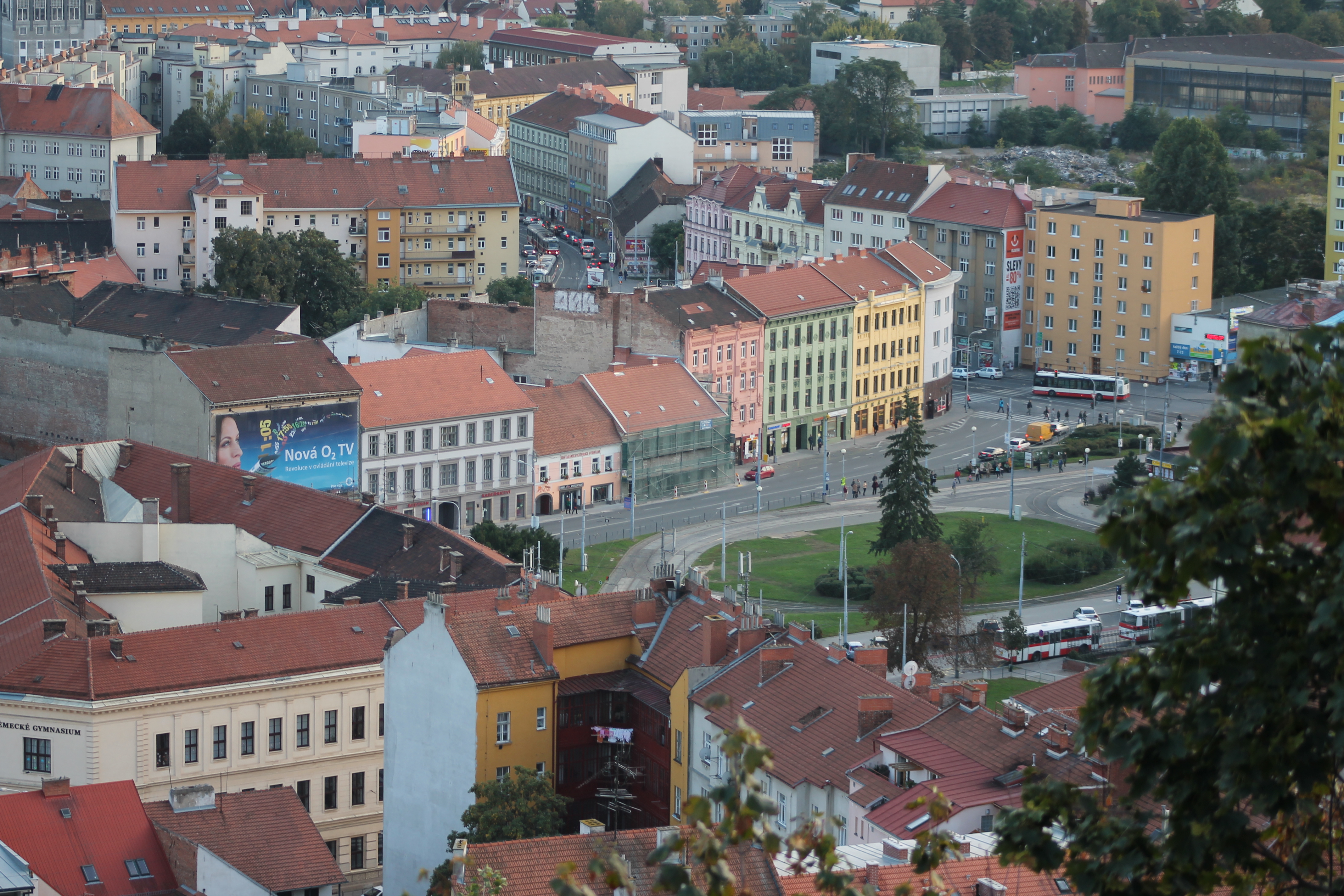
Bird’s eye view of Brno from Spilberg Castle.
Even though the Brno city slicker students knew everything, and knew where everything was, we had our so-called country wisdom. That country wisdom and broader knowledge from the secondary gymnasium guided us through many disasters. We even had a foreign student from Afghanistan, Ismael, who could hardly speak Czech, but made it through the four-year university drill.
The drill consisted of calculus, concrete and steel constructions, architectural drafting. For me, a spirited literary soul, the technical stuff was overwhelming. But, the technical studies were the only way for me to attain a university degree, after our faux pas of returning home for the presidential amnesty in 1973. The communist government punished us by not to letting my dad teach again, and I couldn’t study any humanities. Ironically, the technical studies became my vehicle out.
This is the sixth installment in my adventure travel series from France, Czech Republic, Spain and Switzerland. I started my trip on Sept. 3 out of Lansing, Michigan to explore new and old cultures in support of writing and publication of my memoir “Greenwich Meridian.”
I ventured into the past into Czech homeland to recapture the events that have had impact on our family immigration saga now spanning three generations.
Vizovice, Czech Republic, Sept. 22
When I found myself in front of gated entrance no. 111 Krnovska in Vizovice on a chilly Tuesday morning, my heart skipped a beat. I could hardly recognize the white washed elegant country house on top of a hill with beautiful gabled roof, new windows and flower boxes.
The only remnants of the dilapidated summer dwelling that belonged to my grandparents Anna and Joseph Drabek was the rusty well pump at the bottom of the hill. I could still identify where grandpa put the illegal drainage under the plum trees. The plum trees were long gone but I could still hear him swearing at the sewing machines that he couldn’t repair, and in a distance I heard the lonely tunes of a coronet trumpet.
I sold the house to a local resident with a good reputation, which always counted back in the homeland. I had to sell all my belongings so I could leave former Czechoslovakia forever in1989 to join my husband and parents in USA.
I spent a big part of my life in this house that my grandpa nicknamed as “ranch,” a name that stuck forever. Every weekend, we arrived on a bus with our infant daughter Emma in a carry-on bag to get a reprieve from the captive living in the apartment mega complex Southern Slopes.
Krnovska, Vizovice where the street was the playground.
It was a true ranch, where work and pleasure played equal role. I remember washing cloth diapers outside in the courtyard, a fancy name for a concrete slab with a drain, overgrown by grass.
This is also where I had my very first garden tucked in between the neighbor’s crumbling wall, the plum trees and the grassy two-track driveway.
“Emma, our cabbage looks like it’s been through war,” my grandpa yelled as he examined the perforated purple and yellow heads. “We’ll make sauerkraut and chalamada anyways.”
It was here at the ranch, that I learned how to cook thanks to grandma Anna. Ailing grandma was in charge of all the meal preparations as she directed the show from her Lazarus’ bed, which was the wooden bench on the porch.
A trip to town only a few minutes away was part of the daily routine. Actually, it was more like several trips to pick up different things that arrived at different times of the day, or at different days of the week.
When I think about it today, I would have probably designed an application to make this paramount vital task easier. You had to go early in the morning to buy fresh bakery products like “rohliky” or Czech croissants, but not bread. Fresh bread was only ready after 2 p.m. at the local grocery. Meat and produce where only available on Tuesdays and Thursdays after 2 p.m. Lager beer from Prerov came in on Wednesdays.
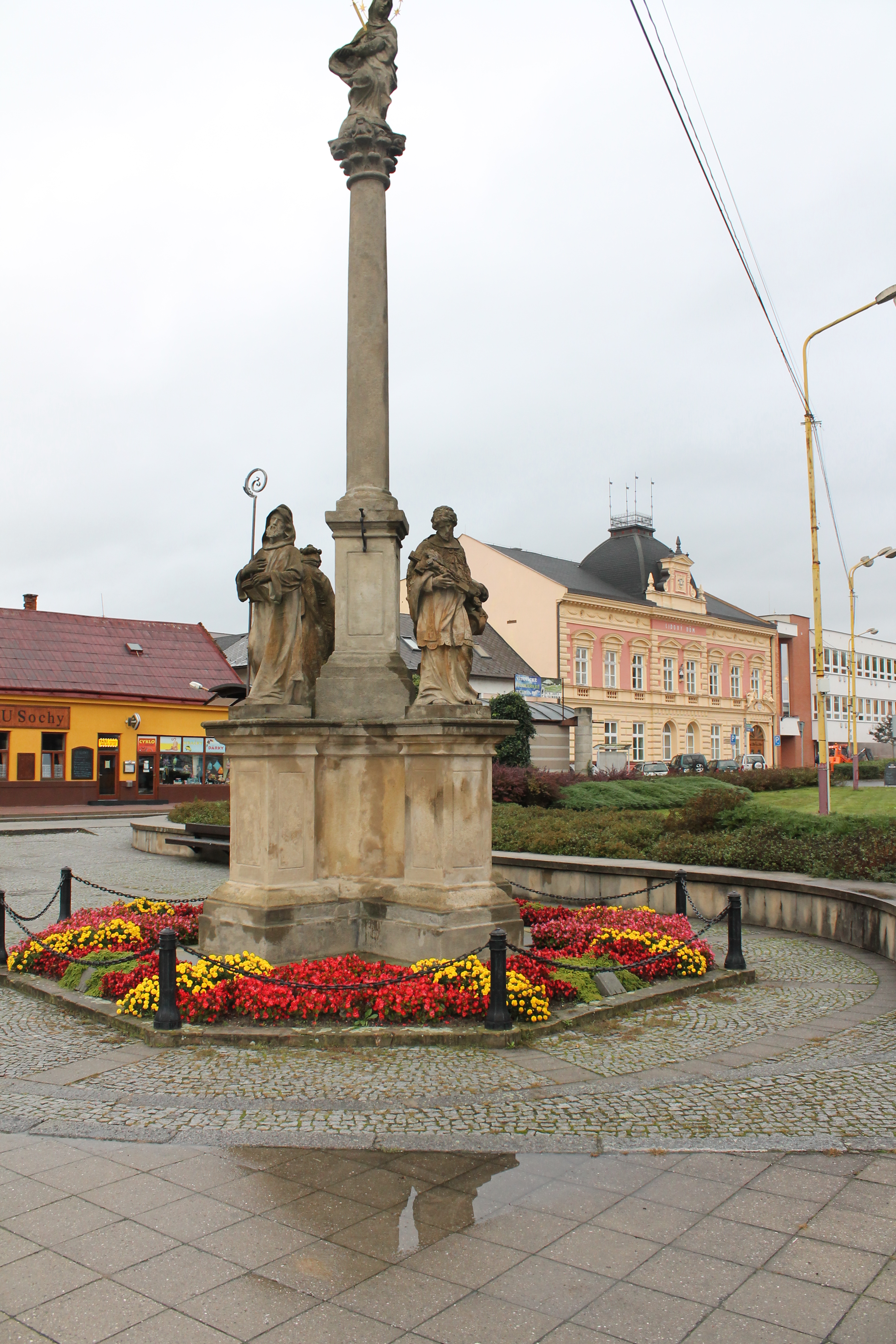
Main Square Vizovice with Marian Column.
In Vizovice, I learned how and when to buy the right meat, which still remains a true art in Czech homeland. Literally, you never knew what you were going to get. Rule no. one was to come early and stand patiently in the line. That too later paid off in my journalistic career.
“Did you know that Mary has been cheating on him?” whispered one broad to another standing in the line in front of me. Both had standard apron dresses on, that are still sold at the textile shops.
“No,” the other broad, wearing a dark blue apron dress, pretended she knew nothing. That way she could find out more.
If you were up front in the line, you could get a good cut. Once I proudly brought in a big piece of meat.
“That pig gave you some carcass instead of chuck,” grandma turned her head upset at the butcher.
As I stood humbled on the Main Square in Vizovice by the Marian column, I could no longer find the old buffet shop that sold the best desserts in town, the coveted Prerov Lager, sweet and sour herrings and Walachian salad.
Creme breeze roll with cappuccino at Tony’s. Some things just stay sweet forever.
The People’s House pub and lodge has been converted into the Vizovice City Hall. It still bears the inscription “ Freedom, Equality and Brotherhood.” All the little specialty shops including dairy with great ice cream Eskimo, bakery and the dreaded meat market have been integrated into a super grocery. The funeral parlor, where I had to check for grandma on most recent deaths, was gone too.
But several venues from the past did stay intact; some repaired, some left in their desolate state. I walked into the old gift shop, “U Kaluzu” where I used to buy gifts for my mother’s birthday. It still smelled of nostalgia. It now sells stationery, and the gifts it sold, were on display in the window as antiques.
“Prejete si prosim?” the woman behind the counter asked me, “How can I help you?”
But, there were also great new finds for me in town like “Tony’s” or U Tonka patisserie and Inn right on Main Square.
I stopped there to have a cappuccino and a true Czech dessert, a great cake roll, now called “Crème breeze.” It all cost 54 Czech crowns, since the Czechs still have not converted to Euro currency. In the eyes of a resident of the European Union, it would have been a cheap buy.
I paused in front of the old elementary school where I started first grade before leaving with my parents for Africa. It is now an arts school.
Chateau Vizovice.
The town is well known for its Chateau (Zamek) Vizovice that hosts concert series, and serves as a venue for weddings. The chateau is surrounded by a beautiful park and fables about fraudulent owners like the fake Count Casperi.
I left the town with a warm feeling in my heart that everything continues to flow and change for the better, while the past has been preserved.
To be continued……University city Brno,Czech Republic where it all started
This is the fifth installment in my travel adventure series that covers three European countries including France, Spain and Czech Republic. I followed the footsteps of my past into Czech homeland as I visited places, friends and relatives that have had impact on our family immigration. I am currently working on my memoir “Greenwich Meridian” about the three-generation saga.
Zlin, Moravia- Sept.16th through Sept.24th
The names of many places, buildings and universities have changed since the fall of communism in 1989. So, as a rule, we had to meet with old friends and relatives best at train stations, because tracks haven’t moved or at bus stations.
In some cases, we even had to set up clues, marks and signs to recognize each other. Some of us had dyed, cut our hair or just plain have grown old and gray.
I easily recognized my friend Liba Hlavenka from Canada whom I haven’t seen in more than two decades in spite of the fact that we live in two neighboring countries.
“You live next to each other,” relatives asked, “That’s crazy you’re going to meet her here.”
Emma Palova with longtime friend Liba Hlavenka in front of train station Zlin.
Well, the distance between Montreal, where Liba lives, and Grand Rapids, where I live, is around 1,000 miles. It was a pure coincidence that we both happened to be in Zlin, Czech Republic, at the same time and in the same year. I wasn’t that lucky with my other classmates who too have immigrated; one also to Canada, the other to Sweden.
The other factor that plays a big role in brief rendezvous in the old country is that we all usually come back only for social occasions. That is most often for funerals, graduations, and rarely for weddings or school reunions. There just never seems to be enough time, money or energy.
I missed all the reunions from the elementary school in Stipa, from the secondary school in Zlin, and finally from the university in Brno. It wasn’t by my own choice. Thanks to modern technology, we could use Skype to communicate during our last elementary school reunion in 2011. However, it is not quite the same thing, as seeing your classmates in their true flesh and blood.
I always say that’s the price we pay for leaving the country where we were born, raised and went to school. We have left behind our living and dead relatives, a different culture and a way of life. Our family ancestors are buried at the local cemeteries, and usually we only get to see the inscription on their headstones.
I tried to recapture all that I have missed over the decades in a flurry of six days visiting the communities of my past: Zlin, Stipa, Vizovice, Kromeriz and Brno.
Kromeriz, UNESCO World Heritage Center.
I met up with my longtime university friend Eva Petrikova-Laurencikova in the beautiful city of Kromeriz on a rainy Saturday. All of my friendships have survived the revolution, the European Union, changes both in politics and economics, changes in careers and partners, as well as the distance across the Atlantic Ocean.
“Do you remember how we used to eat beer cheese in a cup with onions?” Eva asked.
I could not remember the beer cheese, but I did remember the smoked pork knee we used to order in cheap student joints that smelled of beer in Brno.
Here we were, 27 years after graduation; Eva with her two grown children, Emma and John, and me feasting on a smoked pork knee at Velky Orel (Big Eagle) restaurant located on the main Big Square in Kromeriz. Each friend that I managed to see again, wanted to showcase something from the towns where we used to hang out.
“They brew their own beer here,” Eva said.
A lot of the pubs in Czech Republic have jumped on the bandwagon of the microbrewery trend crafting their own spectrum of beers.
Inside Big Eagle restaurant, microbrewery.
We walked the cobblestone streets and squares in Kromeriz that has been designated as the UNESCO World Heritage Center protected for its historical value. Eva showed me the catholic school, where she teaches math. Interestingly enough, each one of us ended up doing something totally different than what we studied, that is construction engineering.
“Since I’ve overseen the construction of our summer house in Velke Losiny, I might go back into engineering,” Eva laughed. “You have to come and write from there. Losiny is a beautiful town with thermal springs close by.”
Flower Garden, part of the Archbishop’s Palace complex in Kromeriz.
We also toured the main grounds of the Archbishop Palace where some scenes from the film “Amadeus” and “Immortal Beloved” were shot. The Archbishop’s Palace boasts a unique arts collection including the prized painting by Venetian master Tiziano Vecelli. I remember when we wanted to go and audition for extras in the movie with my grandpa Joseph for 100 Czech crowns a day. Today, I wish we had. As always, I only regret the things I haven’t done.
As a special treat, we walked on top of the Flower Garden colonnade taking in the perfect symmetry of the gardens and the labyrinths below us.
It is said that if a person speaks at one end of the colonnade, the words echo clearly through to the other side.
I picked up a few long coveted deli items at the local Carrefour before we said goodbye, strangely enough at the parking lot by the cemetery since there is no parking along Lesenska Road in Stipa.
We sent butterfly kisses to each other; hardened by our past, discontent in the present, oblivious to the future.
For more information on Kromeriz go to www.mesto-kromeriz.cz. The info center is located at 50/45 Big Square in town. For more information on Czech Republic go to www. czechtourism.com
PlumFest in Vizovice, Czech Republic features contest in eating plum dumplings
Every year at the end of August, my mom’s native town of Vizovice in Czech Republic celebrates a big plum extravaganza that lasts three days. The annual PlumFest traditionally attracted thousands of people because of its free-spirited nature.
We stayed at my grandparents’ summer house at Krnovska 111. My grandpa Joseph called the old house a ranch, which was a stretch of imagination but it stuck.
Classic plum brandy known as slivovice.
I always invited a lot of friends for the festival from the secondary school in Zlin. So, the three days were a big party inside and outside all over the town. We picked up those who didn’t know where ranch was at the local train station.
Grandpa always looked forward to the PlumFest as much as we did, because he liked to party with us. I only remember him once really getting angry at us, and that was when someone on a Saturday night locked us up and threw the key to the ranch inside a rubber shoe. The next morning that person didn’t remember a thing, and just jumped out the window to catch the first bus.
The rest of us didn’t know where the key was, so we couldn’t let grandpa in. Grandpa thought we just didn’t want to let him inside his own home.
“Let me in you hooligans,” he pounded on the door.
Other than that incident, everything always went smooth. The program usually consisted of different bands including at the time famous band Olympic in the evening.
The town is also home to well-known comedian and mime Borek Polivka, and he quite often made a cameo appearance.
But, mainly Vizovice is known for the famous liquor company Jelinek that makes plum brandy. Plum brandy is exported around the world, and can be easily recognized by the plums on the vignette. Plum brandy also called slivovice was presented as a gift at the Heritage Mass at St. Cyril’s last week at the Czech Harvest Festival in Bannister, Michigan.
Contest in eating plum dumplings in Vizovice.
The major event on Sundays was the plum dumpling eating contest. Brave men sat at a long table on the stage. Assistants brought out plates with batches of 20 dumplings at a time. The rest of us cheered them and encouraged them to eat more.
One champion ate 60 plum dumplings, and then received a certificate and a paid hot dog at the local establishment. I never found out if he ate the hot dog. He could hardly stand up from the table.
The tradition of the PlumFest continues to this day. It takes place at the Jelinek liquor company, and it has been shortened to two days. So, if you want to test your eating capabilities, the contest in plum dumpling eating is this year on Saturday, Aug. 24 at 1 p.m. on Starobrno Stage.
Note: I published a recipe for cream cheese fruit dumplings on my facebook. I will also put it on my author’s page. Even though they’re sweet, they are not considered to be a dessert.











 authoremmapalova