Lowell, MI – In this busy holiday season I needed author Becky Stuit’s prompt to relax today and over the weekend. I’ve been running myself crazy around in circles or spirals as you will.
“When are you going to get the house ready?” asked my husband Ludek on Tuesday as he was stepping over all sorts of stuff laid out on the floor. That is my typical style of designing, laying out things on the floor, so I can see what I have.
I finally wrapped up client E-newsletters yesterday, with more to go on Monday. I have to do two interviews via Skype, which I am really looking forward to. I want to stream the WordCamp live from Philadelphia, since I couldn’t go. I have two stories to write today.
This week has just taken its toll on me.
I’ve never really been able to take a mental break, as advised by both Becky and my husband Ludek.
On any given night, I wake up around 2 a.m. and immediately think about all my projects from writing to design, to shopping, to living, repainting, redecorating and back to writing. And I forget to sleep.
I almost freaked out when I saw the fires in Tennessee followed by the tornadoes. My parents Ella & Vaclav were on their way to Florida passing by pretty close to all the nature’s fury.
Reading Stuit’s post, I realized I need to live more, believe more and enjoy life more. I am going to enjoy my granddaughter Josephine Marie Palova this weekend as much as I can. First early in the morning I will run to the Rogue River Arts Show at the Lowell High School, so I can get a photo of artist/hunter Linda Kropf Phillips (I am writing a story about her).
Then we will speed to the Horrock’s Christmas farm in Ionia with Josephine, take a horse-drawn wagon ride into the fields, cut a tree, have a hot dog inside, roast some marshmallows , decorate the tree and try to catch up with Santa on the Showboat in Lowell.
Relax, girl. It’s all in good time.
And all along, I am trying to live up to the high demands of my surroundings. These include sometimes counselling, as if I know anything about numerology or reading people’s future.
However, my great colleague and friend Annie Conboy of UK ( I am writing a story about her blogging for the past 382 days) says you can do anything through your intuition.
“Just listen to your Guides.”
Well my “Guides” yesterday told me that someone out there needs my help.
I kind of know who it is. I pulled her out of obscurity from the past last spring using a non-conform technique.
“Please tell me something positive,” she begged this week.
“I always tell you positive things, but you never listen,” I said.
Down the road, when the time is right, I will write about this woman. That is once I can sort everything out and getting a mental break.
Guides, can I do all that?
Subscribe to Emma Blogs, LLC E newsletter here today to stay in the loop.
My summer writer’s retreat in France takes me from Burgundy 450 kilometers south into the heart of Provence. Continued from “In Provence” https://emmapalova.com/2016/08/31/in-provence-aug-26-aug-29-2/
By Emma Palova
Provence, FR- Our trip to Provence took us 450 kilometers south of the home base in the wine village of Fixin in Burgundy. After lodging at the Provençal bastide no. 23 on Chemin de la Font du Pin located between Cheval-Blanc and Merindol, we were ready to explore the most beautiful villages of France.
They are: Ansouis, Gordes, Lourmarin, Menerbes, Roussillon, Seguret and Venesque.
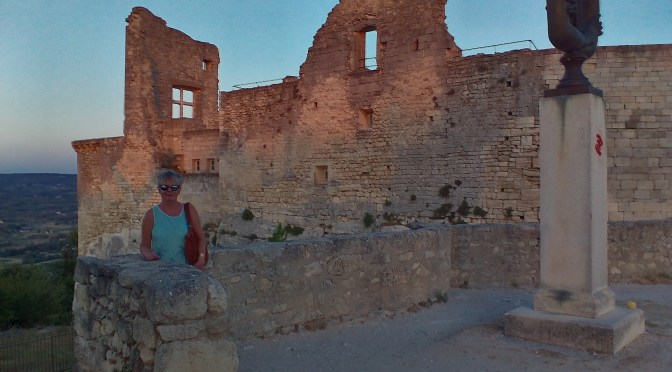
Chateau de Marquis de Sade in Lacoste, Provence.
Hugging the slopes of the Luberon mountain range or its foothills, these charmers share common elements of more than a century of history & arts, cafes, connecting trails, fortifications and majestic châteaux.
At the bastide, our international “ladies squad” loaded up into one car to make the trip up treacherous narrow roads framed by the Luberon easier.
“I hear that you need a Mexican to drive you,” joked versatile Selene who changed her hat from a chef to a skilled driver.
Driving on the narrow roads through the villages of the Luberon is a true art that I have never mastered.
“Do you know who Marques de Sade was?” Emma asked me.
“They didn’t teach us that in Czech,” I laughed.
“The word sadism is derived from his name,” Emma said. “You haven’t seen the Federico Fellini movie “120 Years of Sodomy?”
Now, that grabbed my attention. I love Federico Fellini and until now, I only knew about sadistic dentists and their scary assistants in not so sterile, white offices.
The view from château in Lacoste.
Well, I was just about to find out the story of this exiled aristocrat from Paris.
“An exile in Provence, must be nice,” I thought.
“Yes, he had all these servants and poets on the chateau with him, what an exile,” said sarcastically Claude.
“He spent 30 years being locked up,” Emma said.
Our roadside attractions were olive groves, vineyards, old farm and wine growers homesteads and vegetable plots. Further on in the villages of Les Beaumettes, Goult, Bonnieux, I admired the boulangeries, patisseries and endless restaurants such as the Fuming Cow Café.
The medieval village of Lacoste, pop 450, was built into a steep hill in several levels, a typical fortified structure from the 11th century.
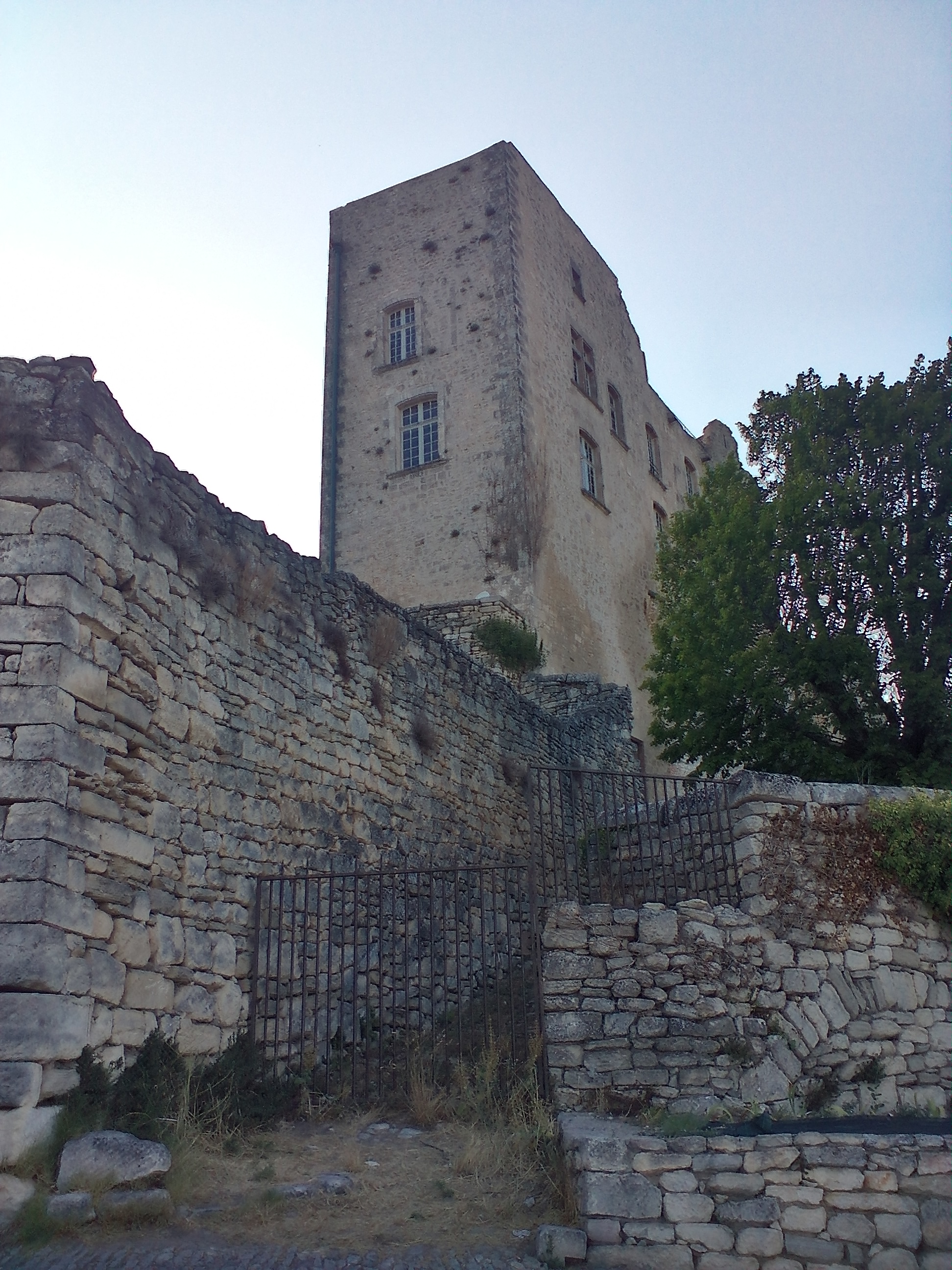
At the peak sits the ruin of the castle of the notorious Marquis de Sade. I took in the surreal view breathlessly.
The beauty of Provence with its fields and “Climats” or vineyards, broken by an occasional road or a village, laid at our feet. The 11th century castle is now home to stylist designer M. Pierre Cardin.
It is not unusual in France, that the castles are privately owned.
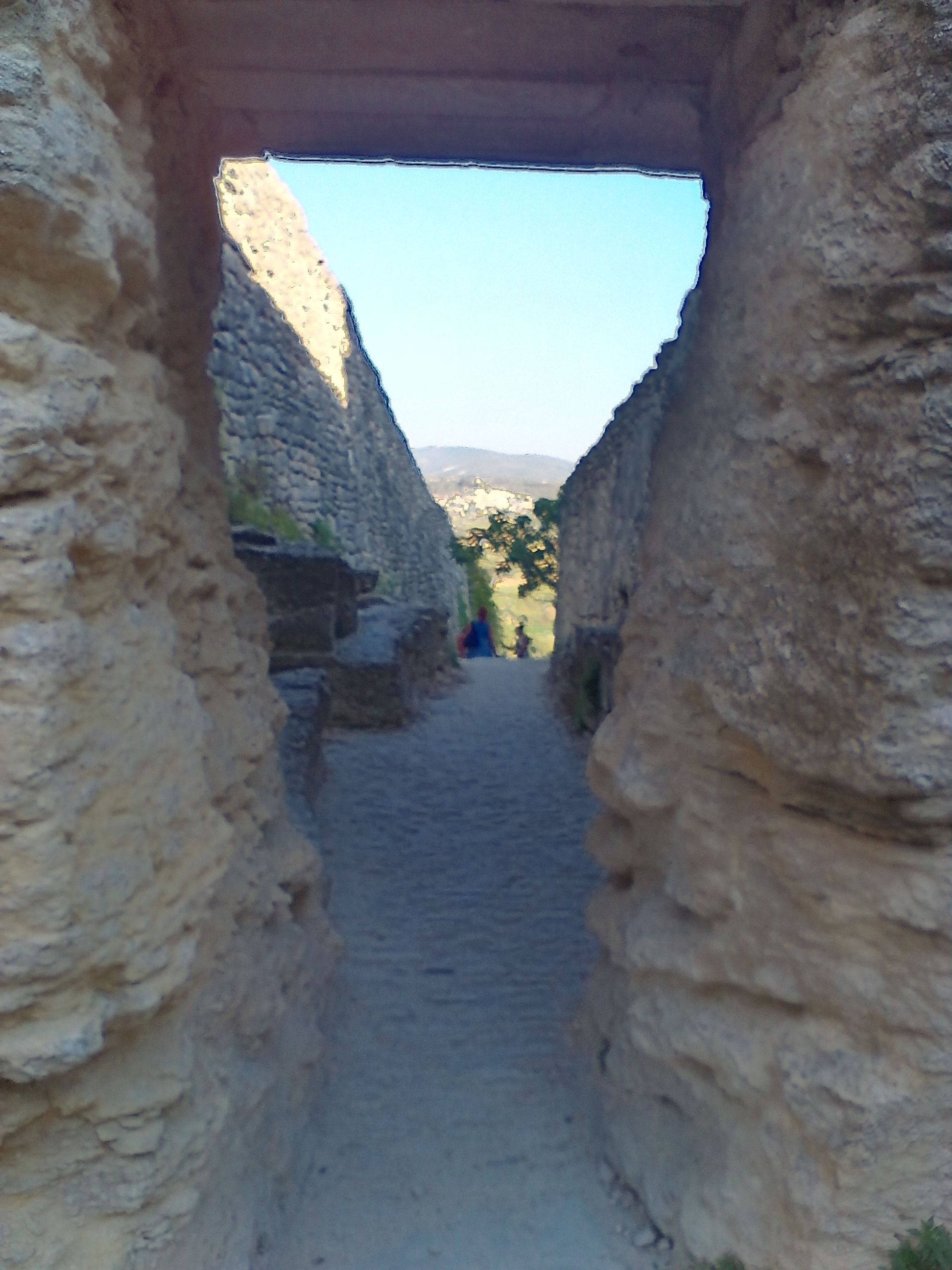
From the top we headed through the ruins down the “calade” cobblestone path to the base of the village. The path was busy with tourists. We passed abandoned boulangeries, open terraces with belfries, and old stone houses, some of which are being restored.
The walk through the chateau ruins in Lacoste.
You closed your eyes and you could imagine the life in this village in the time of Marquis de Sade, live with horses, coaches and escorts that he abused.
The sunset cast soft light on the ruins and sculptures by Greco and other artists. The amazing black“Arms” sculpture embraced the visitors on foot, bikes or on horseback from all over the world.
The café de Sade offered colorful smoothies, regional wines and Provençal cuisine.
Among the activities held in most of these Provençal villages are markets, concerts and festivals.
We prepared our own Provençal dinner at the bastide that featured apero from the olive vendor in Merindol with cheese and olivenade, olives, local bread, beef and turkey brochettes and wine rose from a cave in St. Tropez.
Belfry at chateau de Marquis de Sade in Lacoste.
The dry heat persisted into the evening lit by colorful lanterns and other “lumiere” creations. The conversation carried both in French and English languages. The topic: the beauty of Provence still waiting to be explored tomorrow.
For more information on villages of the Luberon go to: www.provenceweb.fr
To be continued…………… Lourmarin, Ansouis and St. Remy-de-Provence
This is the first post in a series about family relationships that have inspired me to write the memoir “Greenwich Meridian where East meets West” (c)
Some time ago, I wrote the post “Two sisters still at war” about the friction between my mother Ella and her sister Anna aka Anyna. The derogatory version of the beautiful name refers to the relationship between the two aging sisters. Notice that the word Anyna is missing on the greeting card for Anna’s Day.
Anton Chekhov’s “Three Sisters” and Leo Nikolayevich Tolstoy’s “Anna Karenina” kindled my inquisitive mind to further explore relationships and psychology.
Watch as I pick up on the tension between the two sisters. Check out the post at the following link:
Popular name brings back memories By Emma Palova EW Emma’s Writings Lowell, MI- As I was checking Facebook for messages, I came across a greeting card for Anna from the group Czechoslovak Friends o…
May events feature crowds & peaceful manifestations of passion
By Emma Palova
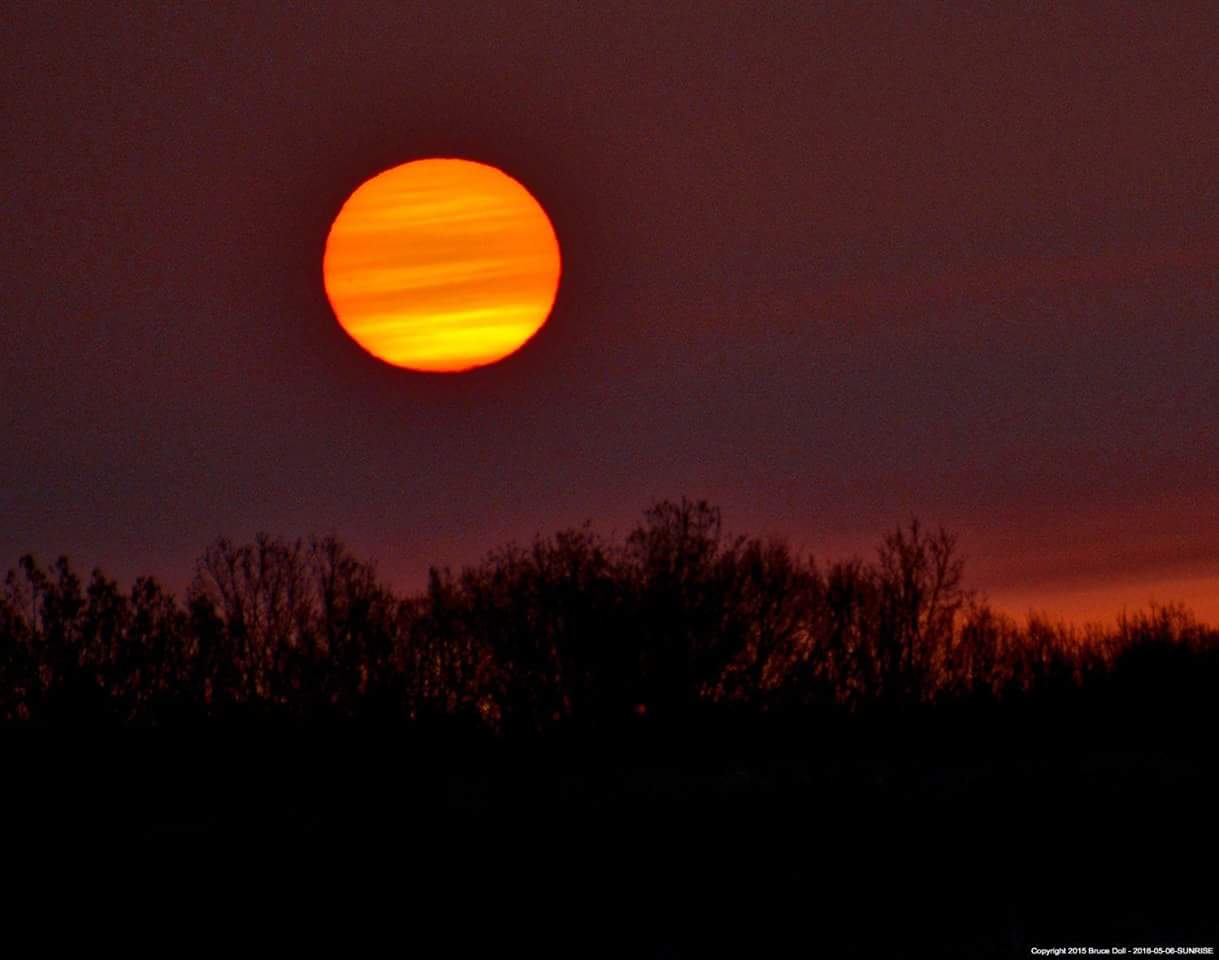
Lowell, MI- In the quiet of an early hour, between night and day, when two energies meet, I am waiting for the daylight to break in.
I cannot see the International Space Station (ISS) orbiting the Earth, because of the clouds. The ISS usually moves over my garden heading south around 4 a.m.
I cannot hear the first bird yet, because it’s not his time. The first song comes around 5:30 right at daybreak.
Time to contemplate events,
I should be meditating, but I am not. Writing is the best meditation. I should be doing yoga, but I am not. Instead, I am exercising my brain.
I should be checking my e-mail, but I am not. Writing this today is more important.
I am thinking about the relativity of events and happenings that are all going on in May. May is the month of love, according to Czech poets and writers. I too celebrate the month of May for its freshness, rebirth and beauty. According to chefs, May is the month of Mediterranean cuisine, and according to the government, May is the Military Appreciation month. It also used to be the Mental Health month, according to mental health institutions.
Most events happening in May are by huge crowd gatherings in pursuit of something. A few of them are peaceful manifestations of passion for something.
The vicious circle of Roundup by Monsanto.
In two hours I will be going to the annual customer appreciation day at Jones Farm Market. My aging parents Ella & Vaclav are coming to join us for a day camaraderie.
But, thinking globally, today are demonstrations around the world against the seed giant Monsanto, the creator of Round-up and GMOs. Both have crippled the environment, humanity, farmers and agriculture.
To stand and watch what’s happening is being a part of the problem. Yet, I have chosen to go to the peaceful farm market in the country. It’s not because I am afraid, it’s because I value bonding with the family more.
Am I feeling guilty? Yes.
I will make up for it by using the power of the word. That is by writing about how Monsanto is hurting us in a very complex and sophisticated way on everyday basis.
Okay I have to stop now to get ready to go to the farm market.
If you still have time, you can get on the Internet and find out about March against Monsanto in your community at
Mother’s Day ties to Greenwich Meridian (c) memoir
By Emma Palova
Lowell, MI- Every year on Mother’s Day, I think about my mom Ella Konecny. That is why I dedicated “Greenwich Meridian” memoir to her. I hope to finish the book within the next few months.
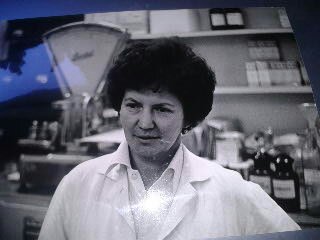
Mom Ella Konecny, the pharmacist
Actually people have been already asking me about the memoir that covers our three-generation immigration saga. I had to put it on hold while I was establishing my Internet presence and my business Emma Blogs, LLC.
Now, that I feel well grounded I am picking back up both fiction and memoir writing.
My mother Ella is both funny and sad. She likes being the center of attention at anyone’s birthday party even at my own. I have a birthday tomorrow, one day before the official Mother’s Day. May 9th was also a national holiday in Czech Republic.
Whenever we gather around the dining table, she stands up and starts telling a joke or whatever she can think of. Ella takes that after my grandpa Joseph Drabek. Her maiden name is Drabkova. The -ova ending to Drabek, is the female linguistic twist to the male version of the name.
Mom, a former pharmacist, is witty, progressive and quickly understands new things like working on blogging projects.
“Do you have to work until you finish it?” she asked on Friday when she brought over birthday gifts early.
Happy Mother’s Day
“Yes, mom. You have to finish a task otherwise you won’t know where you stopped and you might lose it,” I answered.
“Sure. That’s what I thought,” she nodded.
Other than just mentioning info technology, Ella hates it. Both mom and dad are refusing to get a smart phone. That drives my son Jake nuts.
“I want to send them photos of the kids,” he said. “This is crazy, they are fighting it so hard.”
“You can’t force them,” I told him. “They will resist it even more.”
Ella is an awesome cook. Ever since she retired from Ferris State University, biology department, Ella improved her chef skills by 100 percent. Not, that she was a bad cook before, but mom just didn’t have the time.
“What do you want me to make?” she always asks before we come to their home in Big Rapids.
Mom Ella with me on the Venice peer, 2014.
“What do you want me to bring over?” she asks before they come for a visit to our house in Lowell.
So, I have the privilege of picking from a wide menu of choices; anything from Moroccan beef, Stroganoff beef, Chinese to Czech dill sauce with dumplings.
I like to pick kebabs any style.
Mom Ella is a very sensitive person. She cries over both man-made and natural disasters. Mom cried over the oil spill in the gulf that destroyed a lot of marine life. She cries over the situation in Syria. She cries over our lives.
When I see her cry, I cry too. It’s somewhat of an emotional synergy.
She is generous all around; in church, with the family, close and distant and in the developing countries.
She’s getting fragile. Ella will turn 80 next year.
I can’t believe it. My beautiful and kind mother is aging. Last year, she had skin cancer removed from her face. Before that, she underwent countless surgeries, both successful and unsuccessful.
“Everybody lies to me, because it’s easy, I am old,” she said the other day. “Old people get lied to.”
As years go by, Ella is getting more stubborn. She does not want to reconciliate the discord with her only sister Anna, who lives in Czech Republic.
“Mom you should make up with your sister,” I said.
“She doesn’t want to make up with me,” she snapped at me.
Ella and dad have always strove for perfection and to fit in with the most. That may have been hard on them. Ella has a perfectly clean house where everything has its own spot.
She gets upset with me because not everything in my house has its own spot. I like to move things around. I sometimes leave dishes behind.
Ella is very vocal about my life; that I could have done a lot more with it.
“We were at this concert where Ferris students played,” she said Friday. “Can you imagine how those parents felt when they have such successful and serious kids?”
We each have things that bother us. We cover it up, hold it inside or we talk about it.
At a certain point, we have to come to terms with anything that’s depriving us of living a life to its fullest extent.
Mom has given me life and all the tools to live it.
Thank you, Mom.
Yours forever,
Emma
Cover photo of tulips by Emma White Darling of Parnell, MI.
Lowell, MI-In my memoir “Greenwich Meridian,” I write about Czech and Slovak traditions that I have witnessed while living in Czechoslovakia with a touch of nostalgia. Some of them disappeared along with the old regimes, but most have survived mainly in villages and small towns preserved by enthusiastic small groups of people. The traditions are reflected in festive costumes for the holidays and special events, in music, dance, food, and customs specific to each village and town.
We lived in Zlin, Moravia, which is the central part of former Czechoslovakia embedded in traditions. Both as a child and an adult, I lived and visited with my grandparents in Vizovice, a treasure trove of traditions.
Easter celebrations in Czech and some other European countries are longer by one day, and that is Monday.
We have always indulged in lavish preparations for the long Easter weekend. That meant having enough meat, desserts, eggs, and beverages for three days. There were long lines just like before any major holiday. I spent a lot of time standing in lines and listening to what the old broads had to say.
“I am not going to tell him how much I spent,” a woman wearing a scarf and a fluffy skirt shook her head defiantly.
The other one with an apron over her dress smelled of burnt dough.
I thought, she must have burnt her kolache, a traditional festive pastry with plum butter.
The broad leaned closer to the first one and whispered something into her ear. Then they both laughed, until their bellies and chests were heaving up and down. I learned a lot standing in lines. The longer the line, the more I learned.
So, the culmination of it all is Easter Monday known for its “schmigrust,” an old whipping custom.
Traditional Czech festive costumes.
On that day, early in the morning ,large groups of boys and young men head out into the streets with their braided knot-grass whips or oversized wooden spoons decorated with ribbons. The day before, they spent many hours skillfully braiding their whips out of willow twigs or scouring the house for the biggest wooden spoon.
The boys go door to door, reciting traditional Easter carols like “Hody, hody doprovody,” asking the lady of the house for painted eggs. Then, they whip all the present females in exchange for decorated eggs and ribbons. Single women, and girls tied ribbons on top of the whip. I always wondered about the whipping custom, long before I ever set my foot out into the world. One day, grandma Anna finally explained it to me.
“It is supposed to resemble the whipping of Christ before he died,” she said.
“But, grandma that’s evil,” I cried.
Grandma just shrugged, and turned away. Later in life, I knew better than to question a tradition.
The elders in the group were offered shots of plum brandy, usually home made or acquired through bartering. Even family members took part in this ritual. Uncles and cousins were invited inside for coffee, festive desserts such as kolache, shots and meaningful conversation.
On a good year, and especially when I was a teenager, we got anywhere around 100 passionate revelers. Sometimes, I ran out of ribbons. The boys and young men, competing against each other, took pride in the number of ribbons they got. The craft stores had to stock up with meters and meters of ribbons, plain or embroidered. The hens, of course, felt obligated to produce more eggs.
Venice, FL- During my annual writer’s retreats in Florida, I always come across a gem; it may be an artist, a breeze, scuba divers or sand castle builders, students of architecture on their spring break. This is my seventh year on the Gulf Coast exploring treasures washed on sea, and not just seashells.
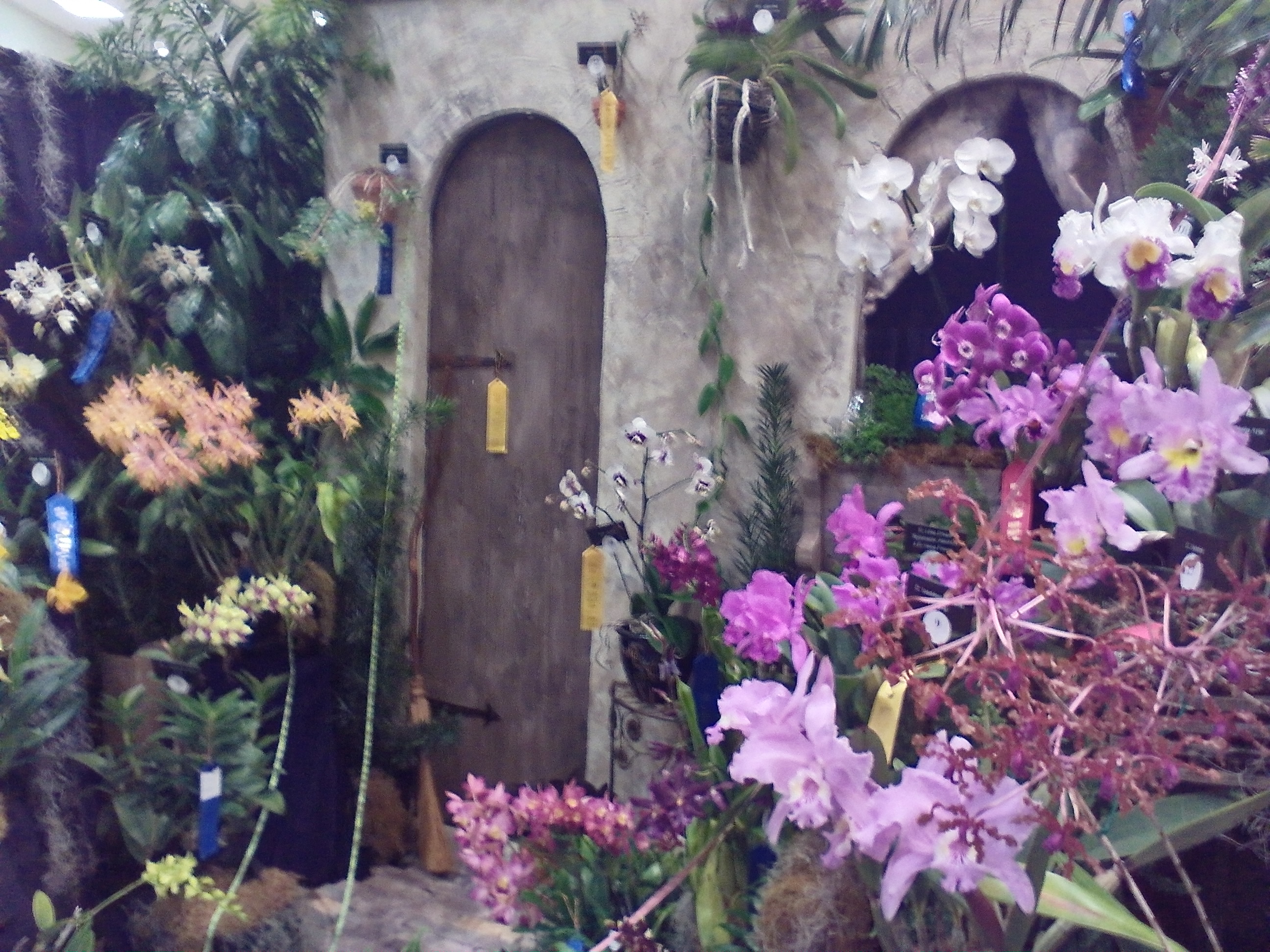
This year, it was the “50 Shades of Orchids” show organized by the Venice Area Orchid Society, (VAOS) an affiliate of the American Orchid Society.
50 Shades of Orchids in Venice
The VAOS is celebrating 50 years of existence. The show is put on at the height of the tourist season and it attracts 3,500 visitors annually and premier growers.
Perhaps, the most striking upon entering the exhibit hall at the Venice Community Center was the unexpected fragrance filtering in from all corners. I am a lifelong lover and collector of these enigmatic flowers. To see the orchids displayed in all colors, shades, hybrids and varieties was stunning.
The orchid stems and spikes were bending under the weight of the magnificent blooms.
Some of the blooms looked more like the faces of animals, birds or butterflies. Others resembled spiders. The large tricolor blooms resembled the Iris or more common flowers home to northern climate zones.
Each display consisted of 50 different orchids, hybrids and species wrapped in palm greens.
VAOS exhibit at the show.
The participating growers offered most orchids for sale including the ones adaptable to various climates like the cattleya, Phalaenopsis, oncidium and vanda hybrids.
My favorite is the ornate Phal that comes in many different shades. I have a nice collection of these that has grown over the years on my windowsills facing the soft northern light.
Years of experimenting have rendered valuable experience. Unlike popular belief the flower doesn’t like a lot of water, only two ounces per week, less in winter. The orchid does not like to have her feet wet. The pots with orchids should be emptied.
Catleya orchid.
There are more than 25,000 orchid species in existence. However, many are being destroyed by poaching and deforestation.
The orchid society promotes conservation and educational projects. It has grown into one of the largest and most active orchid societies in Florida.
The magical orchid can also be found at the Marie Selby gardens in Sarasota, Fl.
Note: This is the second part of a story series, “If I could turn back time” based on a prompt by the WordPress Daily Post that spurred my imagination.
As I start my second story, I look back at a transition time in the early 1990s as the family adjusted to life in North America. This time in Canada. It surprises me that I would like to turn back time to a difficult period in a foreign cold country, where initially I didn’t know anyone, I had no relatives there or any other bonds. I didn’t speak the language and I barely knew how to drive.
Montreal, CAN After immigrating first to the USA in 1989, our family ended up in Montreal the following year. I wanted to join my husband Ludek who got visa to Canada.
It was a long haul, both physically and mentally. The 10-hour drive on 401 through Toronto gave me a lot of time to think.
I haven’t had time to get used to the rural life in US and I was changing the path that would take me to a fully bilingual cosmopolitan city.
At first we lived in a one-bedroom apartment in LaSalle close to the Saint Lawrence River. My husband Ludek and I slept in the living room which was also the dining room separated by a bar top from the kitchen. We had an old green Chevy that my dad Vaclav gave us.
After living with my parents for six months in Big Rapids, MI I was happy I had my kitchen. I didn’t mind the smells coming from the kitchen. I love to cook. I remember the weekly trips to the grocery store. We examined each item twice before it got thrown into the cart. We retrieved some of them later in the next aisle and put them back on the shelf.
Gaspesie, Canada
And it was chicken and chicken again; once roasted, at other times fried, curried or on paprika with sauce and dumplings. Ludek’s friends from Slovakia did the same.
“I’ve had enough of your chicken,” yelled Willi at his brother Joe. “Can’t you cook something else?”
“I could but it’s expensive,” said Joe puffing on his cigarette while he stirred the chicken on paprika.
We made many friends in Montreal. The province of Quebec welcomed immigrants from all over the world.
Days went by fast. I went to COFI, the French Immersion School sponsored by the Quebec government full-time. It was a six month-long intensive course with six hours of French daily. We didn’t have to pay a dime to learn a foreign language. On the other hand, we got paid to go to the French school.
It was a very social and productive time in life. I met Judith from Slovakia and Emil from Rumania, people from Bulgaria, Africa, Japanese and Russians as well as people from all walks of life.
We nurtured our immigrations dreams together side by side sitting in desks with doctors, surgeons, poets, writers, musicians, healers, programmers, factory workers, teachers and stay-at-home moms.
It was at this course that I learnt how to teach languages immersion style.
We were not allowed to speak any other language than French, which was for the better of it, because we wouldn’t be able to understand each other.
We had to act out little scenes from life. I remember I did not want to act in the doctor’s office scene, because I am afraid of doctors and the Rumanian guy Emil liked me way too much.
Ludek worked at a Czech chemical company called Anachemia. Actually, most Czech and Slovak immigrants worked there. I worked in their branch for a while packing medical supplies. This is where I met Liba from the same Walachia region that I came from in Czechoslovakia. We would have probably never met in our homeland and out of all the places in the world, we ran into each other at a factory in Montreal.
We had no mortgage, so we could go skiing in the Laurentian Mountains or drive to Toronto to see a lifelong acquaintance from Technical University of Brno, Dana Pastorcakova who was also from Walachia.
Only, now 20 years later I realize, that it was an advantage not to have a mortgage, because it is what it means.
“Mortgage is a death pledge,” said real estate instructor and broker for Westdale.
Times would prove him right during the mortgage/economic crisis in the mid to late 2000s. My artist friends lost their home on Long Lake.
We moved to a bigger apartment also in LaSalle close to an island in the St. Lawrence River.
“You’re living here like on a vacation,” said Liba during a visit.