Silver Sunday is the second Sunday before Christmas that literally makes the Christmas holiday fever rise by several degrees even though it is usually cold outside at this time of the year. It is also the third Sunday of the advent in the catholic religious year.
Outdoor Christmas markets in most European cities on major squares, are in full swing by now, and they will be open until Dec. 23rd & some on Dec. 24th. The rush is on for everything from nuts and poppy seeds for baking purposes, wooden toys and other crafts, apples and dried fruits, ornaments and keepsakes.
Christmas markets in Czech Republic. Photo by Adela Kobylikova
It’s also time to get a Christmas tree. Although back in Czech Republic most families decorated their tree on Christmas Eve, here in US our family has adapted to the custom of putting up the tree at least two weeks before the magical day. Christmas Eve is a magical day, but a lot has been lost in the translation of the feast of Adam&Eve that falls on Dec. 24th in the Czech name day calendar.
In Czech language, that magical day is called “Stedry Den” which translates exactly as Bountiful Day. Families open a bounty of presents in the evening. I will write more about the customs of that day next week as we draw closer to Christmas.
And even though, I miss deeply some of the customs in Czech Republic, I have replaced them with new ones here in USA.
We cut our Christmas tree early and decorate it before Christmas Eve. Last year we took Ella with us to carry on the new tradition.
Ludek & Ella cut the Palova family Christmas tree at Horrocks Nursery
I couldn’t remember where the tree farms in the area are, so I looked it up on Google Christmas farms in Ionia County and found Horrocks Nursery Farms just north of the city of Ionia.
This year we don’t have our tree yet and I haven’t baked yet either. But my daughter-in-law Maranda Palova made our traditional nutty baskets with filling. I plan on baking chocolate flutes and chocolate mini Ischel cakes. Some Czech and European recipes come with a history. This one comes from the spa town of Ischel in Austria. The story has it that the Austro-Hungarian emperor Franz Josef used to frequent the bakery that made them in Ischel.
As with many recipes there are many variations of the mini Ischel cakes. My grandma Anna used to love them, so I always made them for her. I like to keep that tradition going.
Christmas nutty baskets
Now is also time to send and get cards even in the era of the web. Over the 20+ years here on the American continent, I’ve received hundreds of them, but kept only a few.
One of the few precious ones, a definite keepsake, is a card from Brno with a nativity scene and a score to a Christmas carol. One of the most precious cards that I had sent out was made from a photo at the Meijer store in Cascade.
Although I can’t find it now, I remember precisely what was on it. We were picking blueberries as a family on a farm near Ludington in the 90-degree heat. We’re all holding blue pales and shielding our heads from the scorching sun with funny hats. My daughter Emma was wearing a t-shirt with a Polar bear on it.
“Happy holidays,” the card with mistletoe clip art and snowflakes said.
Speaking about passing on traits and such; both my daughter and I have the same sense for juxtaposition.
Note: This is the fourth installment in the mini-series called “New eyes with Dr. Verdier” about cataracts and eye surgeries. It rightfully carries the bold title, “The Grand Finale.”
The series tracks Emma Palova’s journey from near blindness to new eyes with 20/20 vision. The third part “The Surgery” was published on Oct. 1.
The second part “The evaluation of cataracts” was published on Sept. 13.
The first part “Eyes set on Dr. Verdier” was published on EW Emma’s Writings http://emmapalova.com on Sept. 6.
The Grand Finale
By Emma Palova
EW Emma’s Writings
Grand Rapids, MI- I went into the second surgery even more scared than the first eye because I already knew what was going to happen.
“Each eye is different,” I remembered the anesthesiologist saying.
Dr. David Verdier previously informed me that he was going to adjust the lens for the left eye so it won’t see as far into the distance, but more close-up. That way the two eyes don’t fight, and the result should be a perfect 20/20 vision.
Dr. David Verdier, a recognized eye surgeon
The fear from the surgery caused my blood pressure and pulse to skyrocket. I was sweating in spite of the fact that it was cold in the operating room. I had trouble dozing off under the local anesthesia.
I could feel the work done on the left eye and yellow balls and circles were dancing in front of me. I got a perforated shield on the left eye as well to protect the eye for seven days after the surgery.
When I was hauled into the post-operating stall, I could see my husband as clear as the night sky. Very sharp.
Crisp new 20/20 vision after cataract surgery
I was again the youngest person on the operating premises. Certain type of cataracts strike “younger” people, and unlike the regular cataracts they move very fast causing deterioration of the eyesight.
“It’s like a dirty windshield,” said Dr. Nathan Schlotthauer during the initial evaluation. “New layers keep adding on to it.”
At the height of the cataract ordeal that started two years ago, I could not see myself in the mirror or drive.
Resting in the post-operational stall, I was glad it was all over.
Dr. Verdier entered the stall, “It went very well.”
Next day’s check-up proved my 20/20 vision, and the technician was just as excited as I was.
“You won’t need eyeglasses,” he said.
I got the last schedule for eye drops that would run through Sept. 19. The medication schedule called for the tapering of prednisolone eye drops. Prednisolone eye drops reduce redness, burning and swelling.
As the AcrySof IQ lens implant adjusted in the eyeball, I could see orange circles on the periphery. Sometimes there was tension in both eyes, but the vision remained beyond expectations.
“You see like a hawk now,” said my husband Ludek.
The last appointment at the Verdier Eye Center was on Aug.22. The first evaluation was on July 11.
“You look great,” concluded Dr. Verdier after recording the case. “You have new eyes. We’re very pleased. You were an excellent patient to have.”
“I am ecstatic doctor,” I cried with joy. “I am a new woman.”
In two weeks I saw my referring eye doctor Dr. Holser back in Lowell, who confirmed the 20/20 vision.
“You probably will never need eyeglasses,” he said. “Dr. Verdier is the best. He is worth waiting for.”
A few facts about cataracts according to American Academy of Ophthalmology:
In a normal eye, light focuses precisely on the retina.
In an eye with a cataract, light scatters throughout the eye instead of focusing precisely on the retina causing cloudy vision.
Common symptoms of cataracts are: a painless blurring of vision, glare or sensitivity, poor night vision, double vision in one eye, needing brighter light to read, fading or yellowing of colors.
Most age-related cataracts progress gradually over a period of years, and may be different even between the two eyes.
Other cataracts in younger people may progress rapidly over a short time.
Surgery is the only way a cataract may be removed. However, if symptoms are not bothering you much, surgery may not be needed. Sometimes a simple change in eyeglass prescription may be helpful.
No medications, dietary supplements or exercises have been shown to prevent or cure cataracts.
Cataract surgeries:
More than 1.8 million people have cataract surgery each year in the United States. More than 95 percent of those surgeries are performed without complications.
During cataract surgery, which is usually performed under local or topical anesthesia as an outpatient procedure, the surgeon removes the cloudy lens from the eye. In most cases, the focusing power of the natural lens is restored by replacing it with a permanent intraocular lens implant.
The ophthalmologist performs the delicate surgery using a microscope, miniature instruments and other modern technology.
In many people who have cataract surgery, the natural capsule that supports the intraocular lens may become cloudy over time. I f this occurs, the surgeon may perform an outpatient laser procedure called capsulotomy.
Parnell, MI- I love this Irish unincorporated settlement in the middle of nowhere. I got hooked on it almost 20 years ago, when we were looking for a place to build a house. We found it right here in northeast Kent County, Michigan, some 6,000 miles away from home in former Czechoslovakia.
“I am going to like it here,” I said to my husband Ludek as we drove past the white country church and the old general store.
I can easily list all the establishments in Parnell. There are the Saint Patrick’s Church and school, the cemetery and the Parnell Grocery store.
The parish with its parishioners cement Parnell as they have for the last 170 years. The annual Saint Patrick Festival is the biggest event of the year in the community. It always takes place at the end of June far from the actual feast of Saint Patrick on March 17. But, the weather is better, although unpredictable.
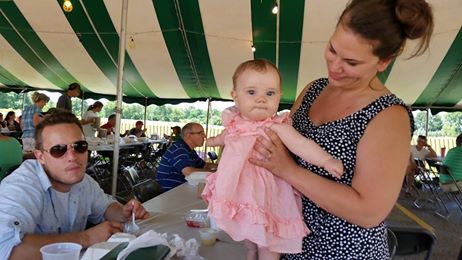
Maranda Lynn with Josephine Marie Palova
Over the years, the festival weather has been from jacket cold to bikini hot.
We found out about the Irish festival early on through channels in Lowell. We’re not Irish by any means, but we lived in Montreal which has a big Irish heritage. We went to the Saint Patrick’s parade there which was complete with bagpipers in skirts.
Saint Patrick festival has become a family tradition, a homecoming when we all get together. My daughter Emma Palova-Chavent usually flies in for Saint Patrick Festival from France.
Dave Simmonds’ bluegrass band Easy Idle that played on Friday festival nights inspired her wedding music and dance back in 2009.
This year, the Conklin Ceili Band played on Friday night. Even without closing my eyes, I could see Michael Flatley and his troop dancing to the Irish band.
I can’t dance the jig, but I can certainly appreciate it.
The Las Vegas night, preceded by the auction, takes place on Saturday nights. I tried my luck a few times and I’ve always lost.
The big get together day is Sunday. After the mass, it’s time for the popular chicken dinners. My parents Ella and Vaclav Konecny always come from Big Rapids to share this special time.
I am not a chicken lover, but the grilled chicken with mashed potatoes, corn, cole slaw and apple sauce is delicious. And the desserts baked by the parishioner women are awesome.
“I don’t have to cook,” mom said victoriously.
Moreover, Saint Patrick parish festivals started popping up around Michigan, according to mom.
“We had one last week in Big Rapids and it raised $18,000,” Ella said.
Much like back in 1850 when the chicken dinners started, I introduced my future daughter-in-law Maranda Lynn Ruegsegger to the tradition.
“I always had to work,” she said. “I am excited.”
Longtime parishioner Ed Donahue said the chicken dinners evolved into the three-day festival. Donahue has been in charge of the dinners.
“It’s a lot more than a fundraiser,” Donahue said.
It is more than a fundraiser. Freelance writer Maryalene LaPonsie received the Dorothy Award after the 5K run Friday for enduring hardship. LaPonsie has been raising five children as a single parent after her husband Tom passed away last year.
Maryalene LaPonsie receives the Dorothy Award.
“I think the festival weekend may have breathed some new life into me,” LaPonsie wrote on Facebook. “I feel better than I have in a while. Hopefully that will carry over to tomorrow when the alarm goes off.”
LaPonsie wrote that she was honored to get the award.
“The only reason I can persevere is because of you my friends,” LaPonsie wrote. “You who pick me up when I fall, you who cheer me on when I despair, you who rush in when I falter.”
Saint Patrick parish festival is definitely more than a fundraiser for the church and the school. It is bonding time for families like ours and Irish descendants far away from home.
On this longest day of the year, I am writing about my Mississippi River adventures. I could use more than one long day that the summer solstice gives us.
Like Pere Marquette, Joliette and McGregor we landed in Prairie du Chien on a hot Friday afternoon to discover the Old Man River. The last time we were here was five years ago.
Annually the city hosts the largest fur trade re-enactment in the Midwest. The river was high after recent rains but did not flood the St. Feriole Island.
On our way to Prairie we bet that nothing has changed in the area for the last 100 years.
Rediscovering treasures on the Mississippi River
Well, we were right except for road construction in the downtown area. And a local businessman completed the remodel of a furniture store.
We crossed the Mississippi to Iowa’s McGregor to stay at Uncle Sam’s Saloon built in 1857 on the landing. The building has been remodeled and updated, but it does have this formidable steep staircase like into a chicken coop.
The view of the town from the porch was marvelous. McGregor is known as “Pocket City” reminiscent of a pocket in the bluffs surrounding the river.
Ludek lived in this Pocket City from 2007 to 2009 and changed living quarters three times as the owner kept selling the houses. The last month he even lived in the nearby Marquette.
Coming back to this place felt like we never left.
The big river is wide here as the Wisconsin River flows into it. Houseboats and boatels were floating on the water, and crews were putting more in. The river gives livelihood to many just like hundreds of years ago.
The 39th annual Rendezvous set-up on St. Feriole Island featured teepees and tents of all sorts. The tents line up the streets on the island. Vendors offered food such as fresh Mississippi fried catfish and turtle soup, Indian fry bread and tacos, fried pickles, frog legs and chips.
Curiosities included steins made from wood and tusks, hundreds of furs and fur hats, rocks and minerals, necklaces and peace pipes.
Competitions featured a black powder rifle shoot, hawk and knife throw, cooking and games for children and adults.
Demonstrations such as blacksmithing, pottery, storytelling took place at individual camps.
Most campers were dressed up in period attire that was also for sale at many outfits.
Lowell, MI- Three things prompted me to think about the writing business: 101 Challenge by WordPress, 100 Posts & beyond that I have achieved in a year and my worsening eyesight.
Sometimes people ask me what would I be if I wasn’t a writer.
“I’d be a queen,” I answer laughing. “The queen of hearts.”
First of all writing is a business and it should be approached as such. I never quite got the idea of some of the Internet writers’ magazines screaming out loud on Facebook:
“Writers, do you want to get paid for writing?”
How is writing any different than going to get your groceries and paying for them? Or gas at the local station? Air ticket?
I love to blog
Actually it should be paid higher than your average retail position because the fact of the matter remains that minority entertains the majority.
“People would die of boredom if it wasn’t for writers and artists,” I always say. “What would you do without us?”
But, there does come a time when you feel like giving up after all the ups and downs, the encouragements and the discouragements.
It is that time when you’re bombarded by self-publishing houses that want your credit card number for your book on demand; by your spouses who want you to make money rather than use it on print cartridges, your aging parents who want to hold that long dreamt about book.
Then, kicks in the thing about driving traffic to your Internet sites and likes, which somehow magically will transfer into sales.
Not to forget about traditional publishers who want everything by snail mail, and 10 months later they still haven’t responded to you.
I don’t know how to change things to get different results or more likes and followers.
I like to encourage others to keep on trying doing the things they want along with the wanted outcomes.
100 Posts on WordPress
My wanted outcomes are the publishing of my memoir and a book, but I seem to be lost in a sea of unexpected results on winding paths. This is not always bad, it’s just something else than you wanted.
It’s like going into the woods to get morels, and instead you bring back blackberries.
“It leads to new discoveries,” I say.
Like in this typical example of having a blog to increase your online presence and publishing capabilities while writing your memoir.
Well, accidentally you pick out WordPress, the best of the bunch. You are a perfect match, and you’re on your way.
“I love doing the blog more than writing my memoir,” I told my husband the other day.
There’s better and instant feedback, the constant challenge of maintaining the blog and coming up with new things, new challenges.
Then in turn you get picked up by other Internet giants and you’re headed into the unknown, like on a spaceship.
On Earth Day April 22nd I reached 100th post on the WordPress publishing platform. I didn’t even know about it until the notification that congratulated me. I kind of felt like “When we put the man on the moon.”
How did I get there?
Based on advice from book agents, I set out to have a definite online presence before the publishing of my memoir “Greenwich Meridian where east meets West.”
At first I wanted to have a website done. A computer dude told me that he does not do websites, but recommended a service that does.
But, in the meantime while doing research for the memoir, I came across a WordPress like box for the Hawkins Chamber of Commerce in Texas.
In order to like and comment, I had to have a blog of my own. At first I was frustrated, but today I am thankful.
Emma Palova
I went into blogging with an open mind, with one class of programming, some design experience from InDesign and Quark Express and 20 years of journalistic print experience.
My first blog post published on January 15th of last year was “Emma Palova biography.”
Just like with anything new there was a steep learning curve in the beginning accompanied by comments:
“Why are you doing this? Let somebody else do it,” said my husband Ludek as he watched me struggle with a post on a Friday afternoon. I wanted to make sure that the posts came out fresh for the weekend for the people to read when they have time.
I am a Taurus, a zodiac sign known for its persistence, determination and sometimes stubbornness.
“I don’t give up easily,” I replied. “Otherwise we would not be here.”
Daily journal keeps track of ideas, tasks
I was referring to our immigration to the USA in 1989 from former Czechoslovakia. I anchored the blog main posts on a mix of stories from the Czech immigration saga and big local stories like Lowell Expo 2014.
Two events further encouraged blogging. First, Writer’s Digest suggested blogging for others to make some revenue. Second, my freelance article on Frozen Creek Floral & Farms was rejected by several publications, while the editors suggested writing for their blogs. Well, I already had my blog EW Emma’s Writings, why would I want to waste my time on courting mainly print publications?
Branching out
So, with Frozen CreekFloral entrepreneurial couple, I branched into the other favorite part of the blog: About localentrepreneurs & artists. This page profiles artists, business people, community members and interesting residents. I received probably the most followers from this section on Entrepreneur Extraordinaire in one day, followed by Of style & substance.
The content has never been a problem for me. I have a million ideas a day. So, if I can get at least two a day formulated and formatted on the web, I win.
But, I share the problem of most writers and artists; I cannot immediately sit down and write what I was thinking about a minute ago. I loiter around, make more coffee, tea, or even worse I eat. In the best case scenario I head out into the terrain to get some photos. I love photography because it feeds into writing and gives me ideas.
Like Hemingway, I am a morning writer. Whatever I don’t get down on the screen in the morning or early afternoon, it just does not make it anywhere. At least not that day.
As the day gets old, so do my ideas and they change into something else into different energy.
To prevent this procrastination, I started a daily writing journal on Norcom composition books. They’re wide ruled and look like a book. In the movie and scriptwriting industry, these are called dailies or in French Le Quotidien.
On each new page, I make a plan for the day. A typical entry tracks on the left side what I need to write that day, ideas and design tasks. I also put the temperature and a sun or a cloud weather symbol on the left side, and my blood pressure readings ha ha ha.
On the right side: I first make a note if I did yoga, meditated and sometimes what I had for breakfast. I make a list of who I need to contact that day with their numbers and what I need to do other than write: meetings, webinars, lunches and such.
Next day, I go back to that page and see what I got done. The composition books have become a great reference for me, and they sit well on the bookshelf. I have accumulated several editions of these dailies. If I run out of ideas, I just turn back to these for reinvention.








 authoremmapalova