Easter Monday traditions in Czech & Slovak villages
By Emma Palova
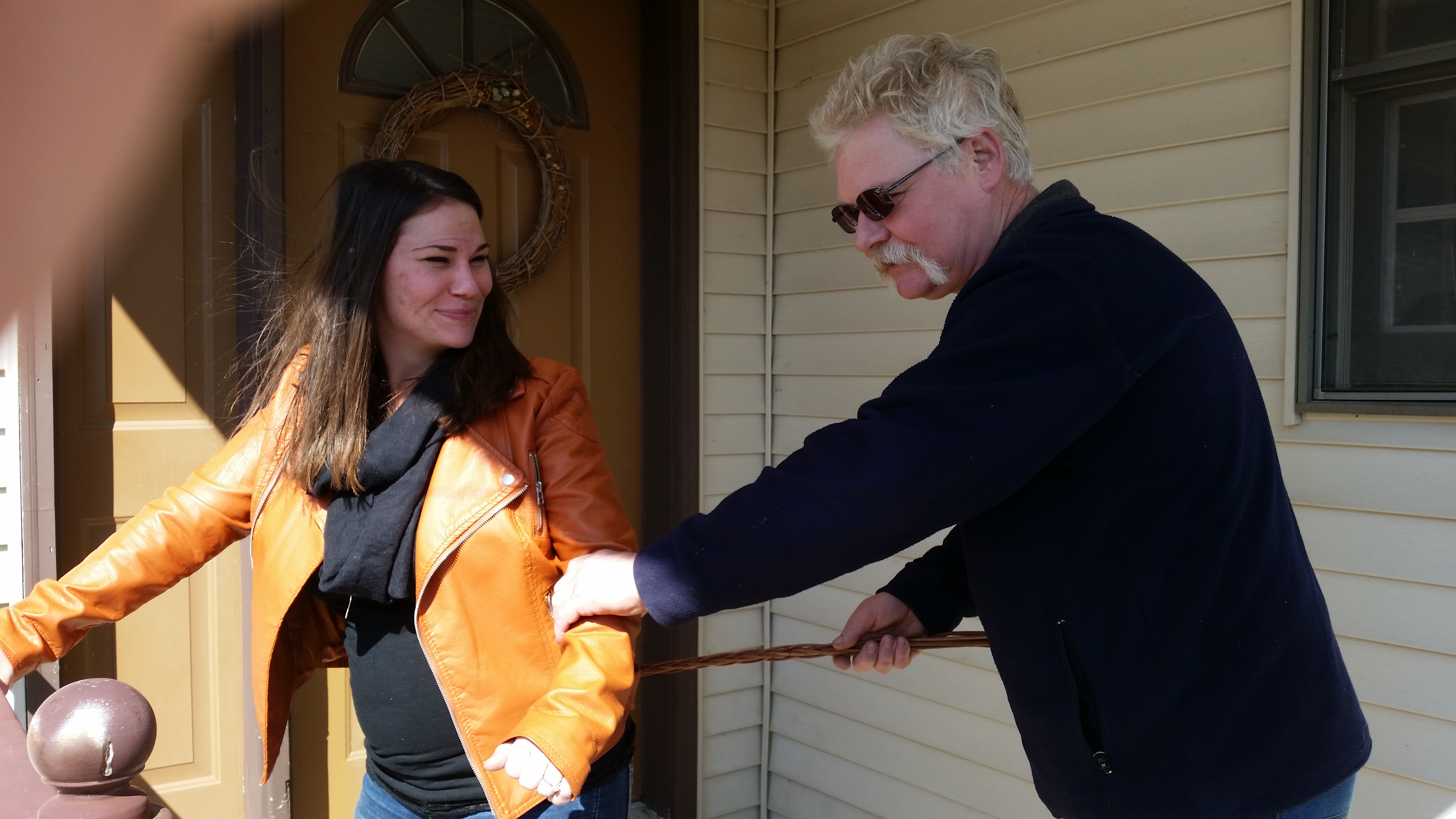
Stipa, Czech Republic- Emma & Ella Chavent get Easter whipping with custom home-made whips on Monday. For French girl Ella, it is the first time participating in an age-old tradition. She will tie a ribbon to the whips.
According to most, the lashing does not hurt.
On Easter Monday in Czech Republic, boys and men in villages head out to whip girls and women of the house. In turn for the whipping, they get shots of plum brandy, eggs and treats. The tradition resembles the whipping of the Christ. It is a holiday. Most men make their own braided whips from willow branches. The big whips have 12 willow branches, that have to be soaked overnight in hot water before braiding. They also have a braided handle. The girls tie ribbons to the whips.
At the end of the day, the groups walk the sidewalks with colorful whips. The whip with the most ribbons becomes a token of pride. The most popular girls run out of ribbons.
In neighboring country Slovakia, the men pour water on the women and girls, sort of like the “bucket challenge” here., as well as the whipping.
The cold water signifies health, beauty and purification.
Here is an excerpt from a Globe & Mail article by Slovak-Canadian writer Miriam Matejova:
“My Slovak Easter traditions mixed paganism with blatant gender inequality,” she wrote. “As a naturalized Canadian, I have treasured my ability to choose the traditions I find appealing and disregard those I detest. I have come to understand that it is fine to let go of some pieces of home and adopt a few new ways instead.”
Lowell, MI-I would like to wish everyone a happy Easter from the EW team. So, you can enjoy it with your family and friends like we do. Our family had to celebrate early, because of our multicultural differences.
Czech Easter traditions and symbols.
We had a great time with Maranda, Jake and Josephine Palova. I even got my weight lifting in by throwing her up and down in my arms. She weighs exactly what I lift, that is 20 pounds.
For our Easter meal we had fried turkey loins with potato salad. Our appetizer featured open-faced sandwiches and classical Walachian salad or fleisch salad.
Czech Easter whipping custom.
In the afternoon, we practiced the Czech whipping custom. In turn for whipping, Maranda and I gave shots of plum brandy to the men.
“This is great mom,” said Jake. “Just like at home.”
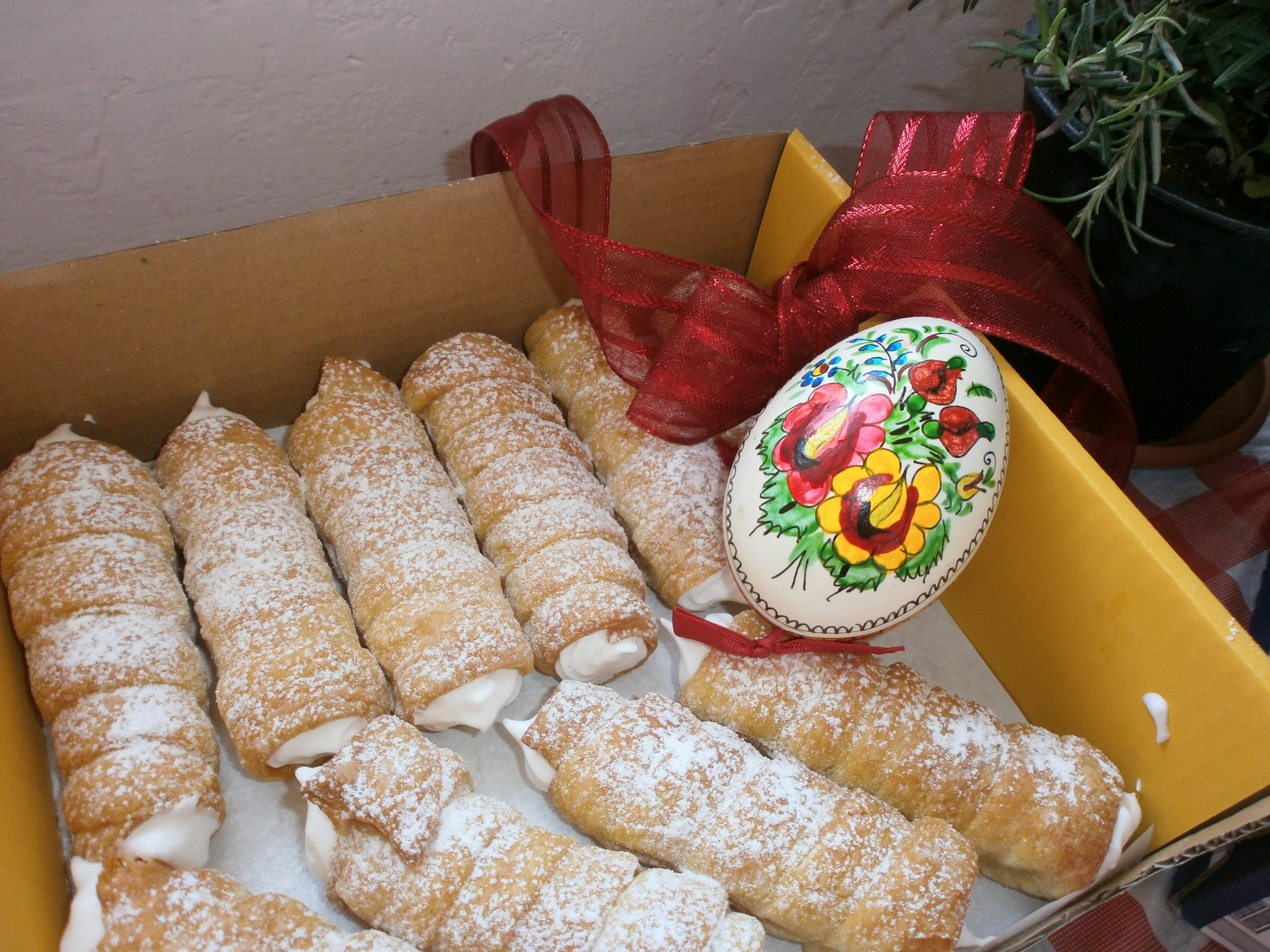
Easter dessertsEaster eggs.
Well, back in Czech Republic, the big day is Easter Monday. Yet to come. Happy Easter to all.
In my memoir “Greenwich Meridian,” I write about Czech and Slovak traditions that I have witnessed while living in Czechoslovakia with a touch of nostalgia. Some of them disappeared along with the old regimes, but most have survived mainly in villages and small towns preserved by enthusiastic small groups of people. Festive costumes for the holidays and special events reflect these traditions, as well as music, dance, food, and customs specific to each village and town.
We lived in Zlin, Moravia, which is the central part of former Czechoslovakia embedded in traditions. Both as a child and an adult, I lived and visited with my grandparents in Vizovice, a treasure trove of traditions.
Cousin Bronislav Pink ready for “schmigrust”
Easter celebrations in Czech and some other European countries are longer by one day, and that is Monday.
We have always indulged in lavish preparations for the long Easter weekend. That meant having enough meat, desserts, eggs, and beverages for three days. There were long lines just like before any major holiday. I spent a lot of time standing in lines and listening to what the old broads had to say.
“I am not going to tell him how much I spent,” a woman wearing a scarf and a fluffy skirt shook her head defiantly.
The other one with an apron over her dress smelled of burnt dough.
I thought, she must have burnt her kolache, a traditional festive pastry with plum butter.
The broad leaned closer to the first one and whispered something into her ear. Then they both laughed, until their bellies and chests were heaving up and down. I learned a lot standing in lines. The longer the line, the more I learned.
So, the culmination of it all is Easter Monday known for its “schmigrust,” an old whipping custom.
Traditional Czech festive costumes.
On that day, early in the morning ,large groups of boys and young men head out into the streets with their braided knot-grass whips or oversized wooden spoons decorated with ribbons. The day before, they spent many hours skillfully braiding their whips out of willow twigs or scouring the house for the biggest wooden spoon.
The boys go door to door, reciting traditional Easter carols like “Hody, hody doprovody,” asking the lady of the house for painted eggs. Then, they whip all the present women in exchange for decorated eggs and ribbons. Single women, and girls tied ribbons on top of the whip. I always wondered about the whipping custom, long before I ever set my foot out into the world. One day, grandma Anna finally explained it to me.
“It is supposed to resemble the whipping of Christ before he died,” she said.
“But, grandma that’s evil,” I cried.
Grandma just shrugged, and turned away. Later in life, I knew better than to question a tradition.
Easter desserts
Women of the house offered shots of plum brandy, usually home-made or acquired through bartering to the “schmigrust” groups. Even family members took part in this ritual. Uncles and cousins visited for coffee, festive desserts such as kolache, shots and meaningful conversation.
On a good year, and especially when I was a teenager, we got anywhere around 100 passionate revelers. Sometimes, I ran out of ribbons. The boys and young men, competing against each other, took pride in the number of ribbons they got. The craft stores had to stock up with meters and meters of ribbons, plain or embroidered. The hens, of course, felt obligated to produce more eggs.
Note: This is the seventh installment in a feature series about Inspiring Women. It is dedicated to all women who are trying to make a difference and better other people’s lives, as well as their own.
In putting together this feature series, I was inspired by several moments in life that in particular stand out.
No.1 A dedication of a Relax, mind, body & soul book by Barbara Heller from my son Jake: “I dedicate this to my inspiring and motivational mother.” Kuba
No. 2 While on a story before Mother’s Day, I dropped in at Ace Bernard Hardware to talk about the prizes with owner Charlie Bernard. We talked also about the Lowell Area Chamber and its director Liz Baker.“You know what I like about Liz, she keeps re-inventing herself,” Bernard said.
No. 3 Again on a story for the International Women’s Day I talked to Sow Hope president Mary Dailey Brown.“If you want to make a difference in this world, seriously consider helping impoverished women. Helping women is the key to unlocking poverty.”
No. 4 At a parents teacher conference at Cherry Creek Elementary in Lowell in mid 1990s: “Mrs. Pala, we do not give up,” teacher Karen Latva said.
Rockford woman sows hope for women of Third World countries
Name: Mary Dailey Brown
Occupation: President of SowHope.org
GVSU non-profit management
Residence: Rockford
Husband: Douglas, two sons Alex & John
Hobbies & interests: golf, photography, video editing, getting together with friends
By Emma Palova
EW Emma’s Writings
Rockford, MI- “If you want to make a difference in this world, seriously consider helping impoverished women. Helping women is the key to unlocking poverty,” said SowHope president Mary Dailey Brown.
Sow Hope president Mary Dailey Brown.
There are hundreds of organizations helping children in the world, but minimum of those that help women get out of poverty.
Brown is working on several projects in Uganda and Democratic Republic of Congo. These include a birthing clinic in Uganda, a micro-project in Congo, projects in India and Pakistan including vocational training and literacy programs in Nigeria and Kenya.
In order to start the SowHope organization, Brown sold the family inheritance farm in 2006. As she traveled around the Third World countries, she noticed the plight of women in Ethiopia.
“I noticed the imbalance of responsibilities,” she said. “Women do all the work, while men get out to the squares, chat and play games. Half of the world lives on less than $2 a day. One seventh of the world lives on less than a $1 a day.”
Brown said that women are suffering disproportionately to men.
“They’re up before sunrise,” she said. “Carrying wood, water, babies, growing food for the families. They use their own strength. Eighty percent of farmers are women, and 80 percent of food is produced by these farmers.”
So, what do men do?
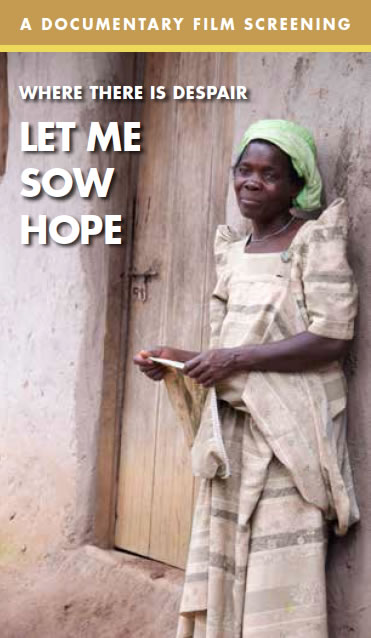
Documentary screened last year in Grand Rapids to raise awareness and funds for IWD.
“They run the government,” she said. “They drive all the vehicles, they handle and run the markets. They sit around the village squares, drink tea, smoke hookahs and play board games.”
Brown uses a translator and she visits with people who are already helping others.
“We provide funds for them,” she said.
SowHope spends about $1.5 million on program costs and the organization has so far impacted directly 46,000 women.
Among the programs are: micro loans to start busineses,, birthing clinics and literacy classes by local teachers.
Many women have been raped and abused.
“We provide emotional care,” Brown said, “and training centers for the villages. We find local leaders and we have 100 teams in 30 countries.”
The success behind these projects is that SowHope already use capabilities in place.
“When we go there as Westerners, we’re imposing our ideas on the people,” Brown said.
She used an example of a female gynecologist in Cairo who goes out and educates women about sex.
“Sex is taboo in these countries,” Brown said. “You don’t talk about sex.”
The doctor gynecologist gives talks at churches.
“It’s very freeing and liberating for them,” Brown said. “A five minute lecture can change centuries of practice.”
The mission of SowHope is to empower the women and to identify their leaders, to give them resources like buying a knitting machine.
The women also face risk from terrorists. Brown spend the week in Nigeria, before the girls were kidnapped.
“Every night we were terrified,” she said. “It was the most terrifying week in my life. The only way to survive is to run.”
SowHope does have a system of criteria in place.
“It depends a lot on relationships and recommendations who we trust,” she said.
There are people like Josephine who helps AIDS widows.
“It’s the most efficient system,” Brown said. “They do the development work.”
What motivates Brown?
“It is the original sense of injustice,” she said.
Did she ever wanted to quit?
“Yes, but my husband told me go into the basement and tell these women why this is so hard for you to do,” he said.
Brown realized that the women were full of dignity and grateful for what SowHope does.
“We want to do holistic care,” she said. “Focus on the basic needs of the women. We want to make it so simple that people can copy us. Women in general are no recipients of sympathy.”
It took three years to get the organization going and to make it sustainable.
And who is Brown’s role model?
“My husband, he is the visionary,” she said. “He helps me stay focused and positive, and not to be discouraged.”
Brown says that the biggest lesson she has learned, is that helping women is the key to unlocking poverty.
Mary Dailey Brown-the woman behind the superwoman 1-What do you do for yourself?
Mary: I want to be a good leader and an inspirational speaker. I also have fund Fridays with Doug and friends. 2- What kind of tips do you have for other women?
Mary: It’s incredibly rewarding what I do. I have feelings of embarrassment that I have struggled. There’s nothing else I’d want to do. 3-What are your plans?
Mary: We would like to expand into other countries, and raise more revenues. We would like to open up affiliate offices around the world.
If you want to donate online contact Mary at SowHope.org
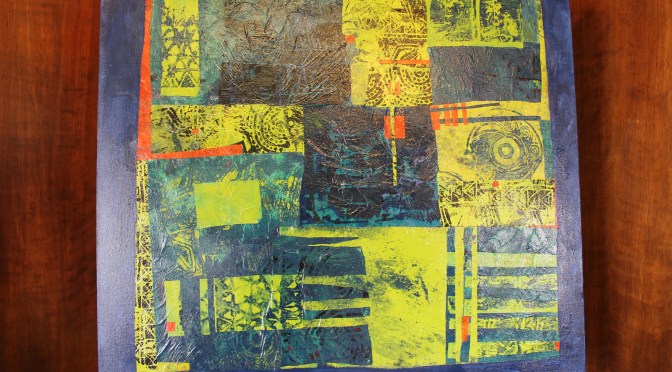
Featured photo by Kathleen Mooney has been inspired by Gee’s Bend quilting tradition. See her story in the archives.
Hastings, MI- In the spirit of the original Octoberfest that honored the marriage of crown prince Ludwig and princess of Saxony on Oct. 12, 1810, we invite all along to celebrate our upcoming international union.
Jakub Pala, born in former Czechoslovakia, will be marrying Maranda Ruegsegger of Saranac on Oct. 25th in the pioneer Saint Patrick Church in Parnell.
The guests, like birds, started to fly in to Gerald Ford International Airport in Grand Rapids as of yesterday. The first batch came from Dijon, France.
First guests from France
The second batch is arriving tonight from Czech Republic. The house will be full to the rafters with kids tweeting like the birdies on the patio.
To honor the international bond between the countries as well as between the couple, we are putting on a “Welcome dinner” celebration this Sunday. This is preceded by the baptism of Samuel Chavent, also at the Saint Patrick Church.
The dinner, catered by AdelineLeigh, reflects our love for our new homeland. We also wanted to introduce our Czech guests to American cuisine. So, barbeque is the theme: bbq chicken, bbq pork, au gratin potatoes, seven layer salad and baked beans. And of course a keg of Samuel Adams Boston lager.
Hops, Czech liquid gold
Much like in Germany, home to Octoberfest, and Austria, no Czech celebration would be complete without beer. Most beers in these countries are high-quality and long-aged lagers made from Western Bohemian hops in small to mid-size breweries.
Czech immigrants carried this tradition with them to other countries.
“Beer is the Czech liquid gold,” according to an old saying.
However, communication between the Czech, American and French guests may be a challenge. So, many of us will serve as interpreters between the three different languages.
Pala, fully bilingual, hopes that his daughter Josephine Marie Palova will speak Czech as well.
“He speaks and reads to her in Czech,” said Maranda.
Pala is very proud of his Czech heritage. He came to the USA when he was 2.5 years old. During our stint in Montreal, Canada in the 1990s all of us were trilingual.
“You’re as many persons as the languages you speak,” according to an old Czech saying.
Follow us on our journey to the international wedding.
I will soon be opening a brand new virtual storefront on all Emma Blogs. I will feature Czech-inspired products such as the Palinka (r) line of canned products.
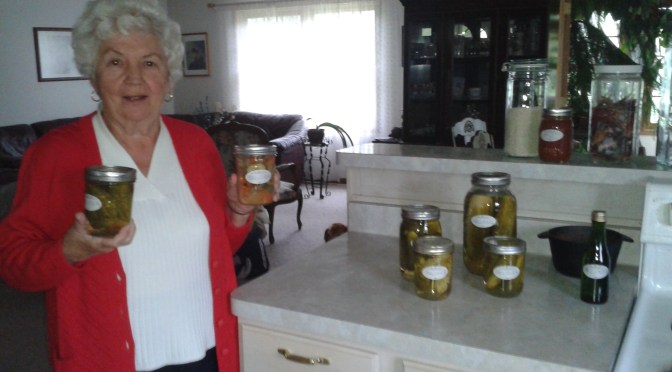
The products such as the sweet and sour dill pickles are all home-made from an old family pickling recipe. The secret recipe has been handed down from generation to generation.
My mother Ella Konecny pictured in the featured photo started canning in the USA during her second immigration in the late 1970s. She didn’t like the sour taste of American pickles or the color.
She would stand up and imitate our grandpa Joseph making a grimace from the sour taste.
“See they twist your mouth,” she said. “We have to start making our own.”
Ella most likely learned how to can from her own mother Anna.
Mom and dad still grow their own cucumbers for pickling. But the weather hasn’t been great for pickles. Ella is also the woman behind the brand name “Palinka.”
My husband Ludek and I are the third generation canning these goodies in our outdoors kitchen.designed for this purpose. Because as the Czech saying goes, “Be prepared to answer when winter asks you what you did in the summer.”
We use only fresh pickling cucumbers sorted by size and cut to the favorite spears, slices or whole. We can other vegetables like red beets and gardiniera mix.
We also make salsa and marinara sauces with either Merlot and basil or Cabernet-Sauvignon with garlic, as well as barrel-aged sauerkraut.
We plan to add more products in the future.
Palinka (r) line of canned goods such as the sweet and sour dill pickles made from an old family pickling recipe. The prices will be $6 per pint and $9 per quart. The gift packages of three different varieties in a wooden carved Michigan box will be $39.99 Stay tuned for the official opening on all Emma Blogs soon.
I will also present my blog design and writing services in an app Emma Blogs format coming soon.
Let me know what you would like to see in this big marketplace by emailing me at emmapalova@yahoo.com
Or you can comment on any of the sites of Emma Blogs. These are:
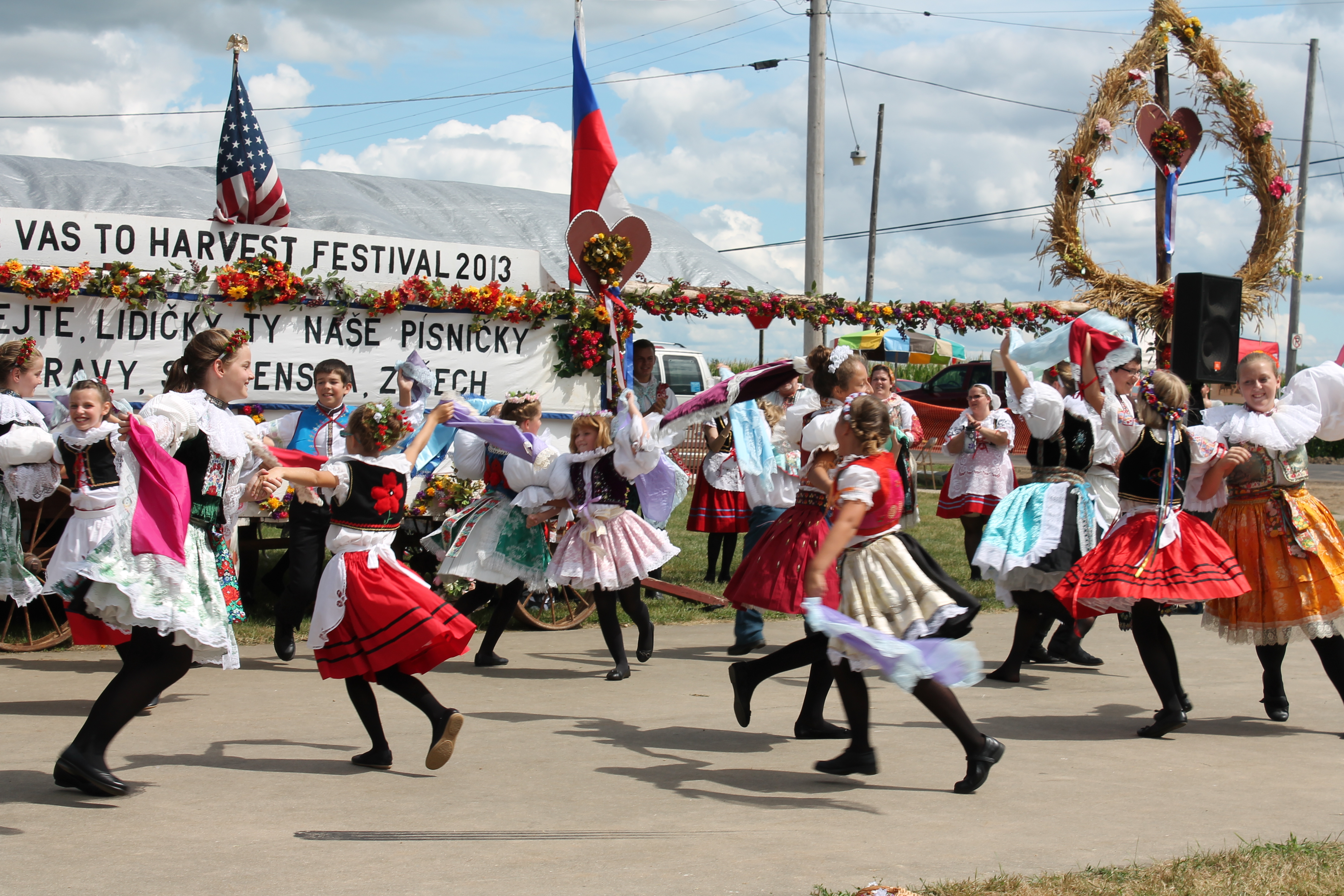
Bannister, MI- Always held on the first Sunday in August, the Czech Harvest Festival in Bannister is by far the best kept secret around.
I discovered it while writing for the Ionia Sentinel-Standard, I received a press release from an insurance agency in Owosso about 13 years ago.
The one-paragraph press release was simple, but it did entice me to explore the “Dozinky” Harvest Midwest style.
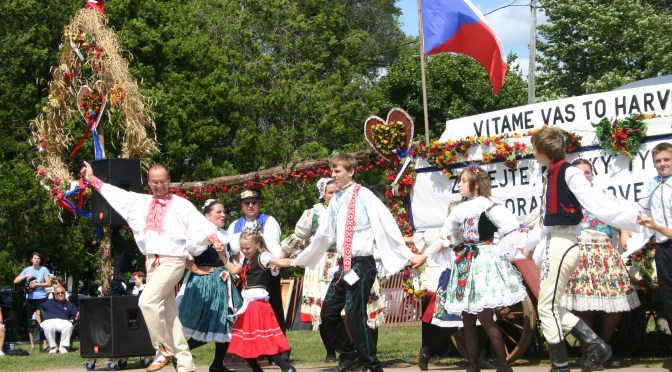
Czech dances in Bannister, MI in traditional costumes custom made in Czech and Slovak republics.
“Come and sample traditional Czech fare of dumplings, pork and sauerkraut. Dance the afternoon away with polka. Watch the dancers in their colorful costumes,” the press release read.
Since then, we’ve been going to the festival at least every two years.
Following is a video interview by Brianna Prochaska with some of the younger participants of the “Dozinky” Harvest Festivals held all over the USA.
My personal favorite is the accordion music by mostly local people. As the old Czech saying goes, “There is a musician in all Czechs.”
What amazes me is that the language is the hardest to keep alive for more than 100 years of Czech immigration to the US. Most festival organizers and women chefs do not speak Czech. But other than that, a small group of people has preserved everything from costumes, dances, music to food.
The universal word here in Bannister is “kolacki.” Kolacki are traditional Czech, Slovak, and Lithuanian pastries filled with cottage cheese and raisins topped with plum butter. Kolacki are a festive dessert used at celebrations such as weddings.
Festive kolacki
The food is a complete Czech feast consisting of dumplings, sauerkraut, pork, ham and chicken. The ham and breaded chicken are American changes. But the cucumber salad with sour cream is as Czech as it gets.
Traditional Czech fare of pork, sauerkraut and dumplings
And as I watch the dancers in Bannister every year or so, listen to the accordions, enjoy Czech food, and check out the old paintings in ZCBJ Lodge in the middle of nowhere, I admire the people behind this event. Most of them have never been to Czech Republic let alone at a classic “veselka.”
The men carry ladies up in a traditional Czech dance.
What the Dozinky organizers have recreated, preserved and continue to pass on to next generations is almost a miracle. I can safely say that most people in the old country don’t know how to dance polka, czardas, or mazurka. The Czech Harvest in Bannister is a testimony that human spirit and determination will always prevail.
The lead dancers are Tom and Diane Bradley. Diane also teaches the youngest troop of dancers.
One of all time favorites for the little ones is the song, “Mela babka ctyri jabka a dedousek jen dve,” or in English: Grandma had four apples, while grandpa had only two. “Give me an apple, grandma, and we’ll be equal.”
According to the chairman of the festival Tom Bradley’s “Pamatnik” published for the 100th anniversary of the ZCBJ Lodge in 2011,the Czechs and Slovaks immigrated to Central Michigan around 1904 from Chicago and Cleveland. They were recruited to work the sugar beet fields. Eventually they worked on their own farms. And the recruiters had to look for different workers from big cities.
The Dozinky Harvest Festival will be held on Aug. 3, 2014 with dinner served from 11:30 a.m. to 2 p.m. for $10 for adults and $3 for children. Get in early, the food does run out.
Authentic gifts such as garnet jewelry and Czech cookbooks are also available.
The program begins at 2:30 p.m. with Bill Nemanis. The dance starts at 4 p.m. at ZCBJ Lodge.
The dinner is preceded by a mass with polka arrangements at the Chuch of Cyril and Methodej.












 authoremmapalova